
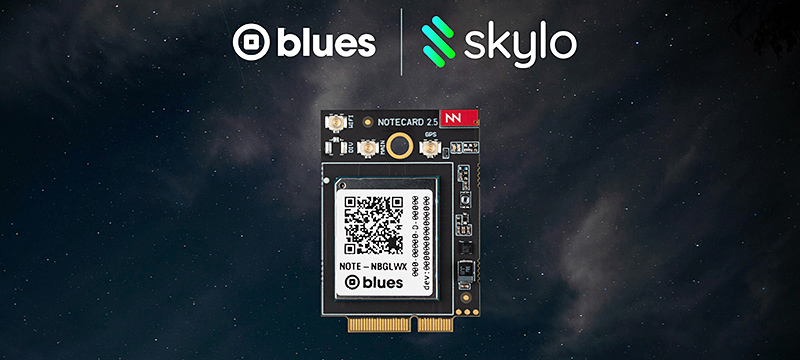
Blues integrates Skylo NTN satellite with cellular and Wi-Fi in a single Notecard IoT module
As enterprises push connected devices beyond reliable terrestrial coverage, multi-bearer designs are becoming a practical requirement rather than a luxury. Blues and Skylo say they are addressing that demand with a single IoT module that combines satellite, narrowband cellular and Wi-Fi with automatic failover and pay-as-you-go satellite usage.
For years, “connectivity resilience” in IoT has often meant stitching together separate radios, antennas, contracts and operational workflows—especially when satellite enters the architecture as a backstop for cellular dead zones. That complexity shows up quickly in real deployments: additional hardware variants, separate activation processes, and the need to forecast satellite usage against subscription minimums.
Blues is now pitching a simpler path. The company has introduced Notecard for Skylo, a module that combines three radio access technologies (RATs) in one product: NTN satellite connectivity powered by Skylo, narrowband cellular, and Wi-Fi. The module is being unveiled at Embedded World in Nuremberg, where Blues says it will demonstrate automatic failover between the three connectivity options.
What Blues and Skylo are actually shipping
Notecard for Skylo is positioned as an expansion of Blues’ Notecard line, adding satellite uplink and downlink to the cellular connectivity available in other Notecard products, alongside Wi-Fi. The key functional promise is automatic fallback: when the primary link is unavailable, the module can drop to secondary and tertiary networks to maintain access to device data.
Blues frames the module as a fit for “mission-critical industries like transportation and logistics, energy, and commercial equipment.” It also offers a straightforward usage example: an asset that uses Wi-Fi in depots, cellular on the road, and satellite in remote regions, switching as conditions change.
Blues also makes a commercial point that will likely matter as much as the radio integration. The company says Notecard for Skylo does not require satellite subscriptions or commitments, describing an approach that avoids monthly satellite subscription fees and minimum commitments, and instead uses pay-as-you-go pricing tied to actual usage.
Notecard for Skylo is slated to be available March 10, 2026, according to the announcement.
Why the “single module” angle matters in IoT
Integrated multi-bearer modules can reduce engineering overhead in several places at once: fewer board-level changes, fewer SKUs to manage, and less operational friction when devices move between indoor, on-road and remote environments. For IoT product teams, the attraction is often less about any one bearer and more about maintaining a consistent device design while widening the envelope of where it can be deployed.
In this case, Blues is explicitly addressing a common satellite IoT hurdle: many solutions require a second satellite module plus a distinct commercial relationship for satellite service. Blues argues its combined approach removes the need for additional hardware and eliminates satellite subscription contracts and minimums—an attempt to make satellite failover a more incremental decision rather than a separate program with its own procurement and forecasting challenges.
The announcement also highlights a broader shift in the satellite IoT market toward standardized NTN approaches. Skylo describes its service as “standards-based” and built around 3GPP standards, aiming to position satellite connectivity as an extension of mobile networks rather than a proprietary island. In practical terms, that narrative resonates with enterprise buyers that want a connectivity roadmap aligned with the cellular ecosystem and its established device and operator supply chains.
Blues is careful to draw boundaries around where this new module fits. The company notes that customers needing Midband (LTE Cat 1 bis) or Wideband (LTE Cat 1) global or regional support should continue to use a Starnote accessory—suggesting that Notecard for Skylo is targeted at narrowband-centric designs rather than serving as a universal module for every bandwidth tier in the field.
The companies are also leaning on an established working relationship. Blues says it previously teamed up with Skylo to launch Starnote for Skylo as an add-on to Notecard, and the new integrated module follows customer demand for a single-module approach to Wi-Fi-to-cellular-to-satellite failover.
As Blues and Skylo take this integrated product to market, the key questions for OEMs and solution providers will be about fit and operational detail: how seamless the failover behavior is in real installations, how satellite usage is managed economically under a pay-as-you-go model, and how the approach scales across fleets where connectivity policies and data costs can vary sharply by region and use case. The core message, however, is clear: satellite is being packaged less as a specialized exception and more as a built-in third bearer designed to keep narrowband devices visible when terrestrial connectivity runs out.
“As adoption grew, it became clear that some of our customers wanted a single-module solution for seamless WiFi-to-cellular-to-satellite failover.”
Brandon Satrom, SVP of Product & Experience at Blues
The post Blues integrates Skylo NTN satellite with cellular and Wi-Fi in a single Notecard IoT module appeared first on IoT Business News.