
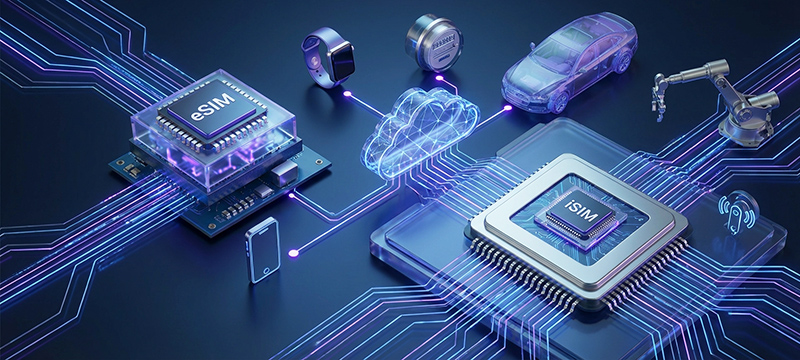
The evolution of cellular connectivity in the Internet of Things is increasingly shaped by the need for flexibility, scalability, and long-term device lifecycle management. In this context, eSIM and iSIM technologies are emerging as foundational enablers of remote provisioning and global deployment strategies. As IoT deployments expand across geographies and industries, the ability to manage connectivity without physical intervention has become a critical requirement.
Both eSIM and iSIM address longstanding limitations of traditional SIM cards by enabling remote subscription management and more integrated hardware designs. While they share common principles, their architectures and implications differ in ways that matter for device makers, connectivity providers, and enterprise adopters. Understanding how these technologies work—and where they fit within the broader IoT ecosystem—is essential for designing scalable and future-proof connected solutions.
Key Takeaways
eSIM and iSIM enable remote provisioning of connectivity profiles, eliminating the need for physical SIM swaps.
iSIM integrates SIM functionality directly into the device chipset, reducing hardware complexity and power consumption.
Both technologies rely on standardized remote SIM provisioning frameworks defined by GSMA.
They support global IoT deployments by allowing devices to switch operators over-the-air.
Adoption depends on ecosystem maturity, including device support, operator readiness, and regulatory alignment.
What is eSIM and iSIM for IoT: Remote Provisioning, Flexibility and Scale?
eSIM and iSIM are embedded SIM technologies that allow IoT devices to store and manage cellular connectivity profiles remotely, without requiring a removable physical SIM card. They enable remote SIM provisioning (RSP), allowing operators and enterprises to activate, update, or switch network subscriptions over-the-air.
In the IoT ecosystem, these technologies address key challenges related to device deployment at scale, especially in distributed or hard-to-access environments. eSIM refers to a dedicated chip embedded in the device, while iSIM integrates SIM functionality directly into the device’s main processor or system-on-chip (SoC). Both approaches support flexible connectivity management across multiple networks and regions.
How eSIM and iSIM works
At the core of both eSIM and iSIM is the concept of remote SIM provisioning. Instead of pre-loading a single operator profile at manufacturing, devices can download and manage multiple operator profiles dynamically.
The architecture typically includes:
Secure element: Stores operator credentials and ensures secure execution of SIM functions.
Subscription manager: A remote platform responsible for provisioning, updating, and managing profiles.
Device management interface: Enables communication between the device and provisioning infrastructure.
In an eSIM architecture, the secure element is a discrete chip soldered onto the device. In an iSIM architecture, the secure element is embedded within the SoC, sharing hardware resources with other device functions.
When a device connects to a network for the first time, it can download a connectivity profile from a remote server. This process is authenticated and encrypted, ensuring secure delivery of operator credentials. Devices can later switch profiles based on location, cost, or performance requirements.
Key technologies and standards
The deployment of eSIM and iSIM relies on a set of standardized frameworks and technologies, primarily defined by the GSMA.
Remote SIM Provisioning (RSP): Defines how connectivity profiles are securely downloaded, activated, and managed over-the-air across device fleets.
eUICC (embedded Universal Integrated Circuit Card): The logical component that enables the storage and management of multiple operator profiles on a single chip.
GSMA SGP.02, SGP.22 and SGP.32 specifications: SGP.02 (legacy M2M) and SGP.22 (consumer) define earlier provisioning models, while SGP.32 introduces a more scalable, IoT-optimized architecture designed for headless and constrained devices, with simplified, cloud-driven provisioning workflows.
Secure enclave / trusted execution environment (TEE): Particularly relevant for iSIM, ensuring secure execution of SIM functions within the device chipset.
Cellular standards: LTE-M, NB-IoT, and 5G technologies that provide the underlying connectivity layer for IoT deployments.
These standards ensure interoperability between device manufacturers, connectivity providers, and platform operators. However, implementation details can vary, particularly in iSIM deployments where chipset-level integration introduces additional dependencies.
Main IoT use cases
eSIM and iSIM technologies are particularly relevant in IoT scenarios where devices are deployed at scale, across multiple regions, or in environments where physical access is limited.
Industrial IoT: Manufacturing equipment and sensors often operate in remote or hazardous environments. Remote provisioning allows connectivity updates without interrupting operations.
Logistics and asset tracking: Devices attached to containers, vehicles, or high-value assets can switch between networks as they move across borders, ensuring continuous connectivity.
Smart cities: Infrastructure such as smart meters, street lighting, and environmental sensors benefit from centralized connectivity management and long device lifecycles.
Energy and utilities: Distributed energy assets and grid monitoring systems require reliable, long-term connectivity with minimal maintenance.
Healthcare: Connected medical devices and wearables can be deployed globally while maintaining compliance and connectivity flexibility.
Automotive and mobility: Connected vehicles rely on embedded connectivity for telematics, infotainment, and over-the-air updates, often across multiple regions.
Benefits and limitations
The adoption of eSIM and iSIM in IoT offers several advantages, but also introduces trade-offs that must be considered at design and deployment stages.
Benefits:
Remote management: Eliminates the need for physical SIM replacement, reducing operational costs.
Global scalability: Supports multi-operator strategies and cross-border deployments.
Improved device design: Especially with iSIM, reduces component count and saves space.
Enhanced security: Uses secure elements and standardized encryption mechanisms.
Lifecycle flexibility: Enables changes in connectivity providers over time.
Limitations:
Ecosystem complexity: Requires coordination between device makers, operators, and provisioning platforms.
Standard fragmentation: Different GSMA specifications for M2M and consumer IoT can complicate implementation.
Operator support: Not all mobile network operators fully support remote provisioning frameworks.
Cost considerations: Initial integration and platform costs may be higher than traditional SIM solutions.
Regulatory constraints: Some regions impose restrictions on remote SIM management or operator switching.
Market landscape and ecosystem
The eSIM and iSIM ecosystem involves multiple stakeholders across the IoT value chain.
Device manufacturers: Integrate eSIM or iSIM capabilities into hardware designs, balancing cost, size, and performance requirements.
Chipset providers: Play a central role in iSIM adoption by embedding SIM functionality into SoCs and ensuring compliance with security standards.
Mobile network operators: Provide connectivity profiles and must support remote provisioning infrastructure.
Connectivity management platforms: Enable enterprises to manage device fleets, subscriptions, and network selection policies.
System integrators and solution providers: Design end-to-end IoT solutions that incorporate connectivity, devices, and data platforms.
The market is still evolving, particularly for iSIM, which depends heavily on chipset availability and ecosystem alignment. eSIM has seen broader adoption, especially in automotive and industrial IoT, while iSIM is gaining traction in highly integrated and power-sensitive applications.
Future outlook
The role of eSIM and iSIM in IoT is expected to expand as deployments scale and connectivity requirements become more dynamic. Several trends are shaping their future trajectory.
First, the transition to 5G and reduced capability (RedCap) devices is likely to accelerate the need for flexible connectivity management, reinforcing the value of remote provisioning. Second, the integration of iSIM into next-generation chipsets may enable more compact and energy-efficient devices, particularly in wearables and asset tracking.
There is also ongoing work to harmonize GSMA specifications and simplify provisioning architectures, which could reduce implementation complexity. At the same time, enterprises are increasingly seeking greater control over connectivity, including the ability to manage multiple operators through a single platform.
However, adoption will continue to depend on ecosystem maturity, including operator readiness, regulatory alignment, and the availability of standardized solutions. As these factors evolve, eSIM and iSIM are likely to become default connectivity options in many IoT applications.
Frequently Asked Questions
What is the difference between eSIM and iSIM?
eSIM is a separate chip embedded in a device, while iSIM integrates SIM functionality directly into the device’s main processor.
How does remote SIM provisioning work?
It allows devices to download and manage connectivity profiles over-the-air using secure, standardized protocols.
Are eSIM and iSIM secure?
Yes, both rely on secure elements and encryption standards to protect credentials and communications.
Can devices switch operators with eSIM or iSIM?
Yes, devices can switch between operator profiles remotely, depending on configuration and operator support.
Is iSIM widely available today?
iSIM is still emerging and depends on chipset integration, but adoption is increasing in specific IoT segments.
Do all operators support eSIM and iSIM?
Support varies by operator and region, and not all networks fully support remote provisioning frameworks.
Related IoT topics
Remote SIM provisioning (RSP)
LTE-M connectivity
NB-IoT connectivity
5G RedCap for IoT
Edge computing and embedded systems
IoT security and secure elements
The post eSIM and iSIM for IoT: Remote Provisioning, Flexibility and Scale appeared first on IoT Business News.