
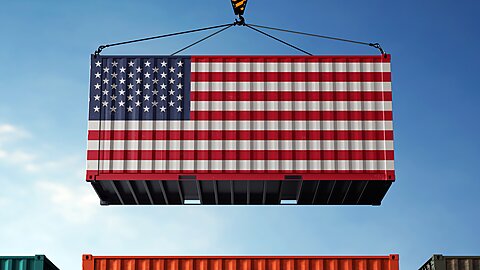
A year ago today, President Trump walked into the White House Rose Garden, held up a poster board with nonsensical tariff rates on imports from virtually every country in the world, and declared April 2, 2025, “Liberation Day.” He told the audience that it would be “remembered as the day American industry was reborn” and that it was “one of the most important days … in American history.” The president declared, “We import virtually all of our computers, phones, televisions and electronics.” He promised that jobs and factories would “come roaring back” and that the US would reduce its reliance on China.
It does appear that a manufacturing boom is happening—just not in the United States.
Earlier this week, Bloomberg published a story about what “Liberation Day” wrought on global supply chains, using China and Vietnam as case studies. Last year, Vietnam surpassed China as the leading supplier to the United States of laptops and other electronics. On paper, this should be a partial victory for the Trump administration—while not reshoring production in America, at least the US is lessening its dependence on Chinese electronics. Scratch beneath the surface, and a different story emerges.
Bloomberg’s analysis found that the core production of those electronics is still happening in China. Faced with unpredictable tariffs, Chinese manufacturers found a cost-effective workaround: moving low-skilled, finishing assembly lines across the border to Vietnam where they face lower levies. It is worth noting the particular irony here: Consumer electronics produced across Asia were exempted from the so-called “reciprocal tariffs,” but goods made in China were still subject to separate fentanyl-related levies of up to 20 percent.
Bloomberg found that Foxconn’s Vietnamese subsidiary “exported $8.6 billion worth of MacBooks, iPads and motherboards for both products and servers, while importing $7.9 billion of various components from China, South Korea and Taiwan. That means at most 7.8% of the export value was created in Vietnam, if all final products at Fukang were exported.” A similar story is occurring with BYD (best known for its electric cars), which also makes iPads for Apple. The net effect on Chinese export exposure to the US was minimal. The roughly $51 billion drop in direct Chinese shipments to America was nearly wiped out by equivalent growth in imports from Vietnam, India, and Mexico. The supply chain didn’t reshore.
As a result, the president’s promised manufacturing renaissance is happening in places such as Vietnam’s Bac Ninh province, where labor demand is so high that first-time factory workers are bused from remote villages and companies are offering signing bonuses of around $570 to attract new hires.
Liberation Day’s Scorecard
Earlier today, my Cato colleagues Scott Lincicome, Alfredo Carrillo Obregon, and Chad Smitson published a terrific blog post providing data and analysis on what the tariffs have produced over the last year. It is not a pretty picture. They document a lobbying bonanza driven by companies desperate to secure carveouts, which helps explain why the supposedly sweeping global tariff regime has become riddled with exemptions. Trade policy uncertainty has increased dramatically. The US tariff system has grown significantly more complex and opaque. Rather than isolating China, the tariffs have accelerated a countertrend: other countries deepening trade and investment ties, including China, with each other as a way to reduce their exposure to erratic American trade policy, with tariffs changing more than 50 times in the last year, according to the Tax Foundation (rate increases, rate cuts, exemptions, inclusions, pauses, etc). Research has shown that American consumers, individuals and firms, absorbed about 90–95 percent of the tariffs’ cost, despite the administration’s repeated statements to the contrary.
In today’s New York Times, Harvard economist Jason Furman explained why the tariffs have failed at creating manufacturing jobs. And the headline manufacturing numbers speak for themselves. Manufacturing jobs declined by roughly 90,000 between April 2025 and February 2026, while manufacturing construction spending fell every month in 2025. The trade deficit—the original sin supposedly causing all America’s (very much overstated) long-run manufacturing decline—increased in 2025. (As Lincicome, Carrillo Obregon and Smitson note, this was partially due to American firms rushing imports before the tariffs went into effect.) Given that about 50 percent of all imports are intermediate inputs, raw materials, and capital equipment, the manufacturing stall was entirely predictable. Tariffs are a tax on domestic manufacturing, not a subsidy.
Tariff supporters’ argument hinges on an investment boom to stand up new domestic factories inside the newly erected tariff wall. The president routinely cites wild and unverified statistics about all the new investment flowing into the United States. Yet these claims have not materialized. Erica York and Emily Kraschel of the Tax Foundation note that the total foreign direct investment in 2025 of $288.4 billion “was below the prior 10 years’ average of $320.7 billion and lower than the annual totals” between 2021 and 2024. In other words, we are still waiting on the promised investment boom, and the instability of the policy landscape is a big reason why it will almost certainly never materialize.
History will likely view April 2, 2025, as a day of economic infamy, not liberation. Although the Supreme Court wisely struck down the president’s initial tariffs, the administration is rebuilding the tariff architecture on different legal scaffolding, so the saga is far from over. But after a year, the tariffs are failing their stated objectives, including their central premise: to reshore domestic manufacturing.