
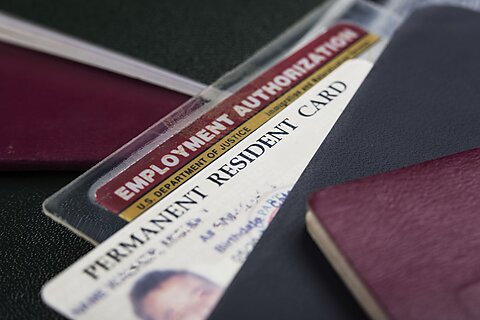
The Department of Homeland Security (DHS) announced Friday that it will cease granting green card applications except in extraordinary circumstances. In short, DHS grants green cards when a qualified immigrant who is inside the United States applies to adjust their status to legal permanent residence. Now, every legal immigrant must leave the country—that is, self-deport—even if they are qualified for a green card and even if leaving would disqualify them.
The policy is a radical expansion of DHS’s “quiet quitting” on legal immigration that has been going on for months. As I previously detailed, DHS—or, more precisely, its component known as US Citizenship and Immigration Services (USCIS)—has slashed green card approvals in half over the last year. This drop came primarily from not processing applications. Now USCIS’s new memorandum details a plan for mass denials. USCIS has gone from the “quiet-quit” to walking out on 1.2 million green card applicants.
“From now on, an alien who is in the US temporarily and wants a Green Card must return to their home country to apply, except in extraordinary circumstances,” USCIS states. It calls adjustment of status inside the United States an “extraordinary form of relief.” The idea that this is an extraordinary form of relief is entirely baseless. This language and framing are not in the statute, section 245 of the Immigration and Nationality Act (INA), which has existed for decades. The law grants the authority to do it, which every administration has faithfully done according to the intent of Congress, until this one.
As the figure below shows, most legal immigrants—56 percent—since 1980 adjusted status inside the United States. In no sense is this a policy reserved for extraordinary situations. The reason it has expanded so greatly over its existence is because more people come to the United States temporarily. More people coming means more opportunities for those people to apply to adjust.
How USCIS (mis)interprets the law.
The USCIS claims that it is contrary to congressional intent to have so many temporary residents applying to adjust to permanent residence. This is wrong. In 1952, Congress created the adjustment of status provision because it was causing so much hardship to Americans and their families to have to leave the United States for the sole purpose of getting a visa to come right back. It was an illogical, complicated, and expensive process with no upside. Since then, Congress has repeatedly attempted to expand the use of the adjustment of status.
USCIS states, “Nonimmigrants, like students, temporary workers, or people on tourist visas, come to the US for a short time and for a specific purpose. Our system is designed for them to leave when their visit is over.” But this ignores the realities of life. People come as students, and then they get a permanent job offer. People come to visit friends, and then they get a marriage proposal. People come for whatever reason, and their country is taken over by someone who will persecute them.
The law explicitly envisions these things happening. The K‑1 visa was designed for fiancé(e)s of US citizens to come temporarily for the purpose of getting married. The H‑1B and L‑1 skilled work visas explicitly permit someone to have “dual intent”—both to come temporarily for work and to pursue a green card at the same time. Employment-based immigrants are explicitly entitled to change jobs based on a long-pending adjustment of status application. Congress clearly expected that many applicants would be applying for adjustment of status, and that backlogs would likely continue.
Who is affected by ending the adjustment of status?
The memo doesn’t explicitly cover asylees and Cuban Adjustment Act cases because it only discusses adjustment of status under one particular section of the law, but it notes that only a few categories—like refugees admitted abroad—have mandatory adjustment of status processing guarantees in law and would be exempt from the logic of the memo (i.e., that adjustment of status is discretionary and disfavored). Therefore, there is reason to believe that the same policy could eventually be used for Cubans and asylees, even though there is no way for them to be granted an immigrant visa. The only way to receive permanent residence is through adjustment of status. As the figure above shows, USCIS has stopped processing these humanitarian categories anyway.
The upshot of USCIS’s bizarre new policy is that the vast majority of the 1.2 million backlogged legal immigrants with pending green card applications for legal permanent residence will have to self-deport. This includes spouses of US citizens and legal permanent residents, as well as their minor children. It includes skilled H‑1B and L‑1 workers who have often waited for over a decade or more for green cards, along with their spouses and minor children.
Further implications:
Forcing green card applicants to leave will render many green card applicants’ ineligible because, when they leave the United States, they will trigger the 3- or 10-year bars on receiving an immigrant visa based on accrual of unlawful presence.
It may cost them their jobs and, therefore, their sponsorship if visa delays prevent them from returning quickly (which is guaranteed to happen based on the flood of new applications).
It will cause them to be subject to the Trump administration’s 75-country immigrant visa suspension and 40-country travel ban (92 total countries)—or half the immigrant visa flow.
It will cause them to forfeit hundreds of millions in application fees.
It will force them to apply at consulates where the doctrine of consular nonreviewability protects any denial from judicial review, and there is no administrative appeals process.
When people are denied, if their underlying status has expired, they will be eligible for arrest and deportation—juicing ICE’s deportation machine.
This policy is illogical and will harm Americans, their employees, employers, and family members. It will drive talented people to other countries and make America a less competitive place for business.