
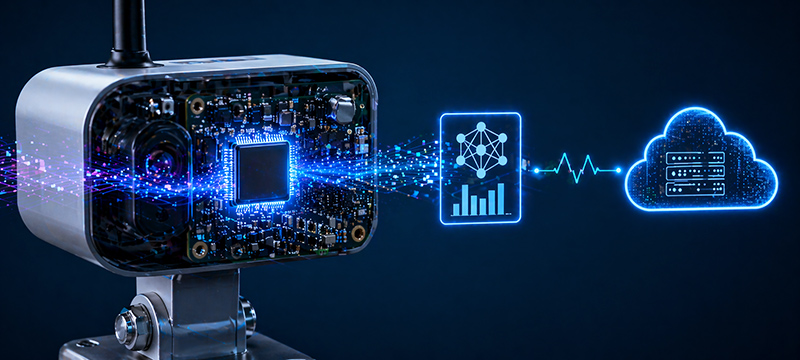
Quectel has announced the FCM665D, a module positioned for edge AI applications. The launch reflects the growing role of on-device processing in IoT systems where sending all data to the cloud is not always practical.
As IoT deployments become more data-intensive, the limiting factor is often no longer just network coverage or device connectivity. Cameras, industrial sensors, mobile equipment and field systems can generate volumes of data that are expensive, slow or operationally impractical to move continuously to the cloud. That is why edge AI has become an increasingly important design consideration: it allows more decisions to be made close to where data is produced.
Against that backdrop, Quectel has launched the FCM665D module for edge AI applications. The company’s announcement identifies the product as a high-performance module, but the available release information does not provide detailed specifications, supported interfaces, processor architecture, AI acceleration capabilities, power characteristics or target certifications.
That absence of public technical detail matters. For OEMs and system integrators, the value of an edge AI module is determined less by the label and more by how it fits into a device architecture: compute headroom, thermal behavior, software support, camera or sensor interfaces, lifecycle availability and integration effort all shape whether a module can be used in production systems.
Why this announcement is different from a conventional module launch
The distinct point in this announcement is its positioning around edge AI rather than simply embedded connectivity or general-purpose device integration. In typical IoT module announcements, the focus is often on radio access technologies, regional network support, certifications or power consumption. Here, the emphasis is on local intelligence, which places the FCM665D in a different part of the IoT design conversation.
That distinction is important because edge AI modules are evaluated by a broader set of stakeholders. Hardware teams need to understand integration constraints. Software teams need to assess model deployment and application support. Operations teams need to consider whether inference at the device level can reduce cloud dependency or bandwidth usage. Procurement teams will also look at whether a module can simplify design compared with building a custom compute platform.
A practical implication is that the FCM665D is unlikely to be assessed only as a component purchase. For industrial players and enterprises, an edge AI module can affect the whole data pipeline. If intelligence is pushed into the device, less raw data may need to be transmitted upstream, but more responsibility moves into the embedded system itself. That can change testing, updates, fleet monitoring and cybersecurity requirements.
For connectivity providers, announcements of this type are also relevant even when the module is not described primarily as a connectivity product. Edge processing can influence traffic patterns on IoT networks. Devices that classify, filter or react locally may transmit fewer high-volume payloads and more event-driven data. That can alter how enterprise IoT services are packaged, particularly in applications where latency, bandwidth cost or intermittent coverage are operational concerns.
For system integrators, the opportunity is more concrete. Edge AI modules can reduce the need to design bespoke compute boards for every project, but only if the module’s software environment, interfaces and lifecycle support align with the target application. Without published specifications, integrators will need to validate those points directly before positioning the FCM665D for customer deployments.
Edge AI is becoming an architectural choice, not a feature label
The broader industry significance is that module vendors are moving deeper into the compute layer of IoT systems. Edge AI is not just a way to add intelligence to devices; it changes where data is processed, where application logic resides and how cloud platforms interact with distributed assets. That is especially relevant in industrial IoT, smart infrastructure, logistics and machine vision use cases where continuous cloud processing may be costly or impractical.
The main takeaway from Quectel’s FCM665D launch is therefore not simply that another module has entered the market. It is that embedded module roadmaps are increasingly being shaped by AI workloads at the edge. The FCM665D will need to be judged on its detailed technical characteristics when those are available, but its positioning points to a clear direction in IoT hardware: more intelligence is being designed into the endpoint rather than reserved for the cloud.
The post Quectel Positions FCM665D Module for Edge AI Applications appeared first on IoT Business News.