
The Jones Act Waiver Has Moved More Energy Than Official Numbers Show
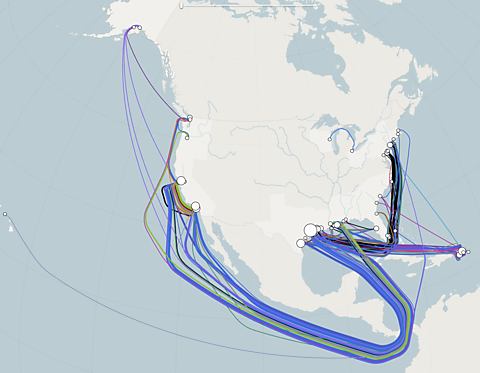
Earlier this month, I noted that the Jones Act waiver has led to record-breaking amounts of energy products being shipped within the US. But it turns out I understated the matter. Bloomberg reported last week that it had identified at least a dozen shipments made under the waiver that were missing from data published by the US Maritime Administration (MARAD), which compiles the voyage reports waiver users are legally required to submit. This means the waiver has been even more successful at spurring domestic energy flows than previously realized.
The article credited me with helping identify some of these missing voyages. I’d like to explain how the gap came to light, what my research uncovered, and why I believe there are no fewer than 15 voyages not counted in MARAD’s waiver tally.
It started with Hawaii. While looking at the islands on a vessel-tracking website in late July, I noticed a tanker sailing toward them from a direction that suggested a Panama Canal transit. That ship, the Marshall Islands-flagged Paula Glory, had departed New Orleans several weeks earlier and had a listed destination of Honolulu, indicating it was likely a ship operating under the Jones Act waiver. The same tracking site later showed the ship entering Honolulu, and a contact at the Grassroot Institute of Hawaii even sent me a photo of the tanker in port.
Eventually, the Paula Glory departed Honolulu with its automatic identification system data displaying a significantly shallower draft reading than when it entered. That change was a definitive sign the ship had discharged cargo. Yet the voyage never appeared in MARAD’s waiver data.
Corroborating evidence of the voyage soon emerged. Records from the National Ballast Information Clearinghouse (NBIC) showed the Paula Glory entering Honolulu on July 25 from Panama, consistent with a Louisiana-origin voyage. NBIC’s logs also revealed something else: a second apparent unreported voyage.
The previous month, another Marshall Islands-flagged tanker, the Cindy Glory, arrived in Honolulu from Baton Rouge. Historical data from VesselFinder, a vessel-tracking website, showed the ship entering its next port with a significantly shallower draft than when it entered Honolulu, providing compelling evidence that it had discharged cargo in Hawaii.
This raised a question: what else might be missing from the official data?
Further digging uncovered 12 additional voyages with strong indications of coastwise transport by foreign vessels that did not feature in MARAD’s reports. The telltale pattern is straightforward: a ship first appears at or near ballast draft at a US loading port, arrives at another US port much deeper in the water, and then appears at a subsequent port substantially lighter. There’s almost no way to explain that pattern other than the vessel taking on cargo at the first port and discharging it at the second.
VesselFinder supplied the draft histories and ports, while NBIC corroborated the latter. For every voyage, at least one port call appeared in both sources. For two of the voyages, those involving Cindy Glory and Nave Luminosity, available draft data didn’t reach back far enough to confirm a light reading at the origin port. Both, however, departed from well-established loading points, with Baton Rouge home to the country’s sixth-largest oil refinery and Houston one of the most frequently used load ports in MARAD’s waiver data.
The 14 voyages identified through this method break down as follows:
Two voyages to Hawaii. Together with a single voyage MARAD did record, that makes three Hawaii-bound tanker voyages under the waiver, compared to no commercial deliveries of Gulf Coast fuel to the state in the past two decades.
Seven to California, which has already received record volumes of Gulf Coast fuel.
Three to Puerto Rico, which has now imported more US petroleum products in six months than in any full year this century.
One to Marcus Hook, Pennsylvania, almost certainly carrying crude oil to the Monroe Energy refinery.
One to New Haven, Connecticut, likely carrying a refined petroleum product.
The vessels comprise one handysize product tanker, ten medium-range tankers, two long-range tankers, and one Aframax crude oil tanker, with a combined cargo capacity of roughly 5.2 million barrels. That provides an upper bound on the amount of oil and petroleum products these voyages may have carried (actual volumes were almost certainly lower).
Importantly, these are almost certainly not a full accounting of voyages missing from MARAD’s data, particularly since my research was limited to tankers operating between different US petroleum districts (PADDs). I made no attempt to identify voyages within a single district, although many such movements have taken place under the waiver.
I did, however, find one more voyage that deserves mention. The Hawaii Fuel Imports Dashboard, whose records begin in 2016, shows the state has sourced propane from the US mainland this year for the first time in its dataset. At 461,429 barrels, it accounts for 50.4 percent of Hawaii’s propane imports by volume so far in 2026.
Moving propane in bulk requires an LPG tanker, but no oceangoing Jones Act-compliant LPG tanker has been in service for decades. That points to a foreign vessel operating under the waiver. Sure enough, NBIC data show that the Liberian-flagged LPG tanker Eiger Explorer arrived in Honolulu on May 22 from Port Neches, Texas, which is home to an LPG export terminal.
The vessel’s listed gas capacity of 78,887 m³ is equivalent to approximately 496,000 barrels, more than sufficient to handle the amount transported to Hawaii from the US mainland this year. The evidence is not airtight, but it’s darn close. That raises the number of apparent unreported voyages identified here to 15.
So why are these long-haul movements missing from MARAD’s totals? The apparent answer is that operators didn’t comply with federal requirements that voyages conducted under the waiver be reported to MARAD within ten days of their completion. MARAD told Bloomberg it lacks the legal authority to compel compliance, and those filing failures should be addressed. But they also mean MARAD’s published totals must be viewed as a floor rather than a complete accounting of the fuel (and fertilizer) moved under the waiver thus far.
These findings further reinforce that the waiver has better connected American energy to American consumers, unleashing both record volumes of energy shipments and trade routes that the Jones Act fleet had not served in decades. With the waiver set to expire in November, Congress should treat these results as a compelling case for more durable Jones Act reform.