
A Libertarian Warned of the New Right’s Authoritarianism 40 Years Ago—Today’s National Conservatives Are Proving Him Right
The terms “Old Right” and “New Right” are commonly used today, but it’s useful to know that they have a long pedigree.
The Old Right of the 1940s, 1950s, and early 1960s, led by Robert Taft politically and people like Frank Chodorov intellectually, generally favored free markets at home and free trade abroad and placed a high value on individual liberty. In the 1970s and 1980s, a group of figures emerged, calling themselves members of the New Right. Their goal was to push the Republican Party in a more nationalist, protectionist, and socially conservative direction. Many of today’s national conservatives, or NatCons, have happily assumed the moniker New Right to distinguish themselves from those conservatives who continue to support aspects of the Old Right credo and favor important parts of their predecessors’ project. Though these two New Rights are not identical, they share many beliefs, especially the use of government power to advance their agenda, which threatens economic freedom and individual liberty.
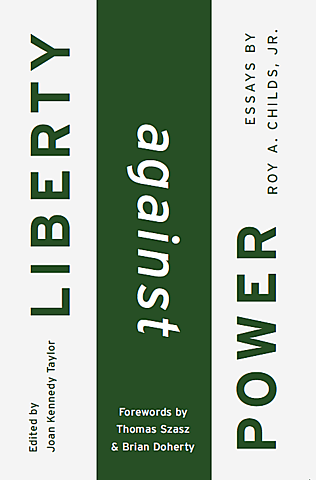
Libertarian Roy A. Childs, Jr., warned about those ideas in his essay, “The New Authoritarians,” published in Inquiry magazine in 1982. That article, a review of three books on the New Right, is included in the 2026 edition of Liberty against Power, a collection of Childs’ essays published by Libertarianism.org, a project of the Cato Institute.
Childs, who died in 1992, was an intellectual juggernaut in the libertarian movement, known for his brilliance and love of liberty. He edited the Libertarian Review, nurtured many young writers, worked as a policy analyst at the Cato Institute, and was the lead book reviewer at Laissez Faire Books.
In “The New Authoritarians,” Childs warned that the New Right was abandoning the principles of limited government and free markets in favor of imposing its own social and economic vision. His warning exposed a movement that presented itself as a defender of freedom.
The New Right seeks “the replacement of what it sees as a liberal establishment by its own populist, authoritarian movement,” wrote Childs. “[It] has jettisoned the old conservative principle of limited government and the libertarian principle of the free market. … The New Rightists accept many of the institutions the liberals created, but in place of a big government manipulating society to promote liberal values, the New Rightists want to use state power to promote social-conservative and nationalistic values.”
They favored a conservative version of technocracy, embracing aspects of central planning and a close partnership between business and government. Quoting activist and author Kevin Phillips, Childs writes that the New Right “would be based not on a nostalgia for free-market economics, but on a corporatist approach—something that could be called an ‘Economic Security State.’”
Those collectivist ideas are ascendant today among NatCons. Their intellectual leaders are people such as philosophers Patrick Deneen of the University of Notre Dame and Yoram Hazony of the Edmund Burke Foundation. Some also wield power in the Republican Party and hold positions in the Trump administration. Prominent figures in this movement, including Vice President JD Vance, support tariffs, protectionism, economic nationalism, immigration restrictions, and related forms of interventionism. Instead of limiting state power to protect individual liberty, the movement wants to use that power to impose its vision of the national interest—what it often calls “common good conservatism.” That is precisely what Childs warned about more than four decades ago.
In National Conservatism: A Statement of Principles, its signatories give much praise to limited government, rule of law, the family, and non-discrimination—all worthy principles. But they support interventionism and declare “the free market cannot be absolute”—”[e]conomic policy must serve the general welfare of the nation.”
They do not specifically define the “general welfare of the nation” or the “common good,” a term often used by NatCons. It is an undefined and undefinable concept. Politicians can justify almost any intervention by claiming that it serves the nation. And they will shape economic policy toward that end.
As they write, “a prudent national economic policy should promote free enterprise, but it must also mitigate threats to the national interest….” Legitimate threats to national security must be addressed. But history shows that politicians regularly appeal to the national interest or a “national emergency” to advance their own agenda and reward favored industries—all at the expense of consumers.
Political leaders might say, for instance, “We should protect American steel because steel production is strategically important to the nation.” But as Ayn Rand would have argued, “If American steel cannot compete, government has no right to force consumers to buy it.” The same principle applies to automobiles. Should the government restrict your ability to buy a Toyota to protect Chrysler? Why should politicians decide which products Americans may buy, and which industries get favored treatment?
The NatCons approach seems to overlook the fact that consumers—not government officials or business executives—determine what gets produced. As Ludwig von Mises observed, even the big businesses “depend entirely on the patronage of those who buy its products. The biggest enterprise loses its power and its influence when it loses its customers.” Business exists to serve consumers, not the other way around.
American Compass—a think tank that embraces many NatCon ideas and that published a collection of essays last year titled The New Conservatives—claims that the “breakdown in American capitalism over the past half-century is most apparent in its failure to deliver widespread prosperity for the American people.” But that diagnosis overlooks how much government policies have distorted markets, blocked competition, and protected favored interests.
As for prosperity, Americans today enjoy dramatically higher inflation-adjusted incomes than Americans did 100 years ago; they live longer, spend less of their lives working to afford basic necessities; and they enjoy access to technologies and conveniences that were once unimaginable.
That’s apparently a secondary point for the NatCons and, ironically, for much of the political left as well. Both sides want to subordinate free-market enterprise to political goals, often in the name of the national interest or the common good.
As Cato’s Norbert Michel wrote, “Both progressive populists and nationalist conservatives share the flawed premise that central planners in Washington know how to manage capital better than free individuals acting in competitive markets. But history has proven repeatedly that when the government overrides market price signals in the name of the ‘common good,’ it destroys economic predictability, creates shortages, and drives up costs.”
Using government to impose preferred outcomes, from the right or the left, does not solve these problems. It compounds them. One side may invoke the national interest or the common good; the other may invoke economic equality or social justice.
Rand wrote in 1965, “When ‘the common good’ of a society is regarded as something apart from and superior to the individual good of its members, it means that the good of some men takes precedence over the good of others.” In an essay on nationalism, Cato’s Alex Nowrasteh and Ilya Somin wrote that it is “an ideology of group rights that denigrates individualism in favor of an abstraction called ‘the nation.’ … In crucial ways, nationalism is just socialism with different flags and more ethnic chauvinism.”
The danger is not that every government intervention makes an economy socialist. But the accumulation of interventions distorts markets and leads to more interventions. Ludwig von Mises warned that the continual interventionism by the government “is a method for the transformation of capitalism into socialism by a series of successive steps.” It’s not coincidental that the Wall Street Journal ran a 2025 story with the headline, “Trump Keeps Blurring the Line Between Capitalism and Socialism.”
Childs saw the underlying problem. It is a constant civil war, he wrote, with “liberals and conservatives, each trying to impose their own values by government action—that is, by force.”
There is a better way: libertarianism. It means respecting individual freedom and individual rights, allowing people to live as they choose without imposing their choices on others. That means rejecting both the New Right’s economic nationalism and government planning and the progressives’ utopian vision of a classless society.
We need to “live and let live,” said Childs. His warning remains critical today. Neither the right nor the left has a legitimate claim to use government power to force its vision of the good society on everyone else. A free society requires more than putting the correct people in power: it requires limiting the power government can exercise over all of us.
To obtain a copy of Liberty against Power, click here. Note: The Cato Institute’s research library at its Washington, DC, headquarters is named in honor of Roy A. Childs, Jr.