
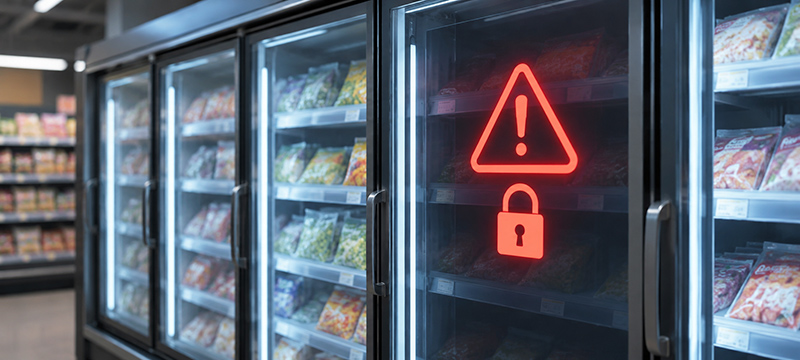
European Supermarket Cyberattacks Expose Security Risks in Connected Refrigeration Systems
A second wave of cyberattacks targeting supermarket refrigeration systems across Europe has exposed vulnerabilities in connected operational technology. Wireless Logic warns that network-level security and continuous monitoring are becoming essential to protecting critical IoT infrastructure.
When hackers gain control of a connected refrigeration system, the consequences extend far beyond a conventional IT security breach. Temperature settings can be manipulated remotely, food stocks destroyed and business operations disrupted within hours. For retailers increasingly dependent on connected equipment, cybersecurity has become a direct operational risk.
On November 2, supermarkets and other food retailers across at least seven European countries experienced disruptions to their refrigeration and freezer systems following suspected cyberattacks. The incidents affected businesses in Belgium, Sweden, the Netherlands, Estonia, Luxembourg, Finland and Ireland, with some refrigeration units reportedly reaching temperatures of 50°C.
The latest incidents follow a similar attack on October 12 that affected hundreds of French supermarkets, forcing retailers to discard substantial quantities of refrigerated and frozen products.
Connected Refrigeration Systems Become a Cybersecurity Target
Unlike conventional cyberattacks focused on stealing information or disrupting corporate IT systems, these incidents targeted operational technology (OT) responsible for controlling physical equipment.
According to reports from affected retailers and refrigeration service providers, attackers remotely manipulated refrigeration controls, including activating defrost cycles and changing temperature settings. The resulting disruption caused food losses and forced some stores to remove products from sale.
The incidents highlight a particular vulnerability in connected commercial refrigeration: equipment designed primarily for reliable temperature management may remain operational for years while its remote access interfaces, software and security configurations become outdated.
Reports have linked the affected installations to refrigeration management systems supplied by Danfoss. The company has indicated that outdated software and insufficiently protected network connections contributed to the incidents. However, the full scope of the attacks and whether they were centrally coordinated remain unclear.
For operators of distributed refrigeration infrastructure, the challenge is compounded by the number of systems deployed across individual stores, warehouses and logistics facilities, often managed remotely by external service providers.
Wireless Logic Calls for Network-Level IoT Protection
Commenting on the incidents, Iain Davidson, Head of Product Marketing at Wireless Logic, stressed that cybersecurity failures in connected infrastructure can translate directly into physical and financial damage.
“The fact we have seen a second major attack on supermarkets less than a month after the recent incident in France shows that cyberattacks now reach well beyond data theft. Compromised IoT infrastructure causes physical damage and heavy financial losses.”
Davidson identifies aging operational technology as a significant concern. Industrial controllers and refrigeration systems may continue using older firmware that no longer receives regular security updates, while remaining connected to remote management platforms through cellular, wired or Wi-Fi networks.
Wireless Logic argues that protecting individual devices is not sufficient, particularly where legacy equipment cannot easily be updated or retrofitted with modern security capabilities.
The company instead advocates network-level visibility, including AI-driven anomaly detection capable of identifying suspicious communication patterns and blocking connections to potentially malicious IP addresses.
This approach addresses an important limitation of device-centric security: operators may not have direct control over the firmware or security configuration of every connected asset, especially when equipment comes from multiple manufacturers or is maintained by third parties.
However, network monitoring is not a substitute for securing remote access. Its effectiveness depends on visibility into relevant communications, while compromised credentials or legitimate management channels can make malicious commands harder to distinguish from authorized activity.
What the Attacks Mean for Industrial IoT Deployments
The significance of the supermarket incidents extends beyond food retail. Similar operational dependencies exist in cold-chain logistics, pharmaceutical storage, industrial manufacturing and other environments where connected controllers manage temperature-sensitive processes.
For enterprises and system integrators, the incidents reinforce the need to assess cybersecurity across the complete IoT deployment rather than concentrating exclusively on individual endpoints.
Practical measures include restricting internet exposure, strengthening remote-access authentication, updating vulnerable software, segmenting operational networks and monitoring unusual device activity. Independent temperature alarms and clearly defined incident-response procedures can also help reduce the impact of unauthorized changes.
Connectivity providers have a role in this architecture, particularly where cellular IoT networks enable remote management of geographically dispersed equipment. Network isolation, traffic visibility and controlled access can provide additional protection without requiring modifications to every installed device.
The central lesson is that connected equipment creates a potential path from a cybersecurity incident to physical operational disruption. As the European refrigeration attacks demonstrate, securing that path requires coordinated protection across devices, communications networks and remote management platforms.
The post European Supermarket Cyberattacks Expose Security Risks in Connected Refrigeration Systems appeared first on IoT Business News.