How Com4’s Nordic-Built Connectivity Keeps Europe’s Digital Signage Networks Running
From Oslo Central Station to bus stops across Scandinavia, ZetaDisplay is proving that digital signage is only as good as the connection behind it, and that connection is Com4.
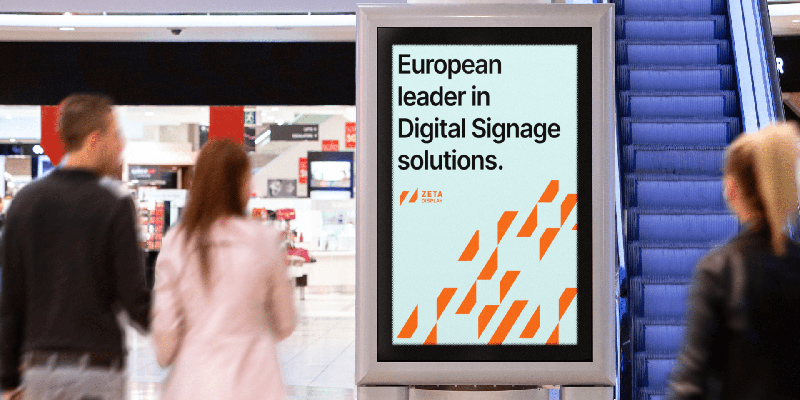
If you’ve waited for a bus, boarded the Oslo Airport Express Train, or checked departures on Europe’s largest digital information board at Oslo Central Station, chances are you’ve interacted with a ZetaDisplay screen without realizing it. These digital signage solutions have become so seamlessly woven into daily urban life that most passengers never think about what keeps them running. Behind every screen is Com4’s IoT connectivity, a Nordic-born network built for exactly this kind of mission-critical reliability.
A Nordic Partnership Built on Trust
ZetaDisplay’s roots trace back to 1999, when the company operated under the name Pronto TV. Its very first customer, Flytoget, the Oslo Airport Express Train, remains a customer today, making it one of the longest-running software contracts in the Nordic region.
Since being acquired by Swedish company ZetaDisplay in 2016, the business has grown into one of Europe’s largest digital signage providers, operating in eight countries with roughly 270 employees. In Norway, ZetaDisplay’s client roster includes Flytoget, Montér, Saint-Gobain, Bjørklund, and Ruter, the public transport operator responsible for information screens at bus stops, metro stations, and tram stops throughout the greater Oslo region.
As a Nordic company itself, Com4 understands the operational reality of this market: harsh climates, dispersed infrastructure, and customers who expect connectivity to simply work, without compromise.
The Connectivity Challenge Behind the Screens
For any digital signage provider, uptime isn’t just a metric, it’s the entire value proposition. A black screen means lost impact, lost revenue, and lost trust.
The challenge is that many of ZetaDisplay’s screens sit in locations where running fixed lines is difficult or simply impossible: bus stops, tram platforms, and outdoor public spaces where fiber rarely reaches. Local Wi-Fi, meanwhile, often isn’t reliable or secure enough for screens delivering time-critical public information.
There’s also a technical ceiling to consider. Older 2G-based solutions could only handle simple text, a limitation that doesn’t hold up against today’s expectations for rich graphics, real-time data feeds, and continuous API-driven content updates.
Security adds another layer of complexity. Com4 operates across highly regulated sectors, including banking and healthcare clients like Norsk Helsenett, which means every connection needs full encryption, end-to-end visibility, and continuous device monitoring, a standard of operational excellence that underpins all of Com4’s IoT deployments.
Solving It with Cellular-First Architecture
ZetaDisplay’s answer was to deploy Com4 SIM cards across every display where Wi-Fi or fiber isn’t a viable option, turning Com4’s mobile connectivity into the secure, always-on link between each screen and ZetaDisplay’s cloud-based content management system, Engage Suite.
Each installation pairs a Windows-based PC with an industrial 4G modem and environmental sensors tracking temperature, brightness, and humidity. The moment a screen powers on at a customer site, it connects to the cloud via Com4’s network and automatically pulls or streams its content, no manual configuration required.
For Ruter, this architecture enables something particularly powerful: screens display real-time information based on the live GPS position of buses, trams, and subways, with data refreshed from Ruter’s systems and reflected on-screen within seconds, powered end-to-end by Com4’s connectivity technology.
The system proved its worth during the pandemic. With 4G connectivity from Com4 in place, Ruter was able to instantly push infection-control messaging and dynamic updates across its entire public transport network, something the older 2G infrastructure simply couldn’t have supported.
“As long as we have an online connection, we can access any screen directly to troubleshoot, test and update software without sending a technician. This is crucial when you have thousands of devices in the field,” says Marius Lysholm, Country Manager at ZetaDisplay.
Every connection is secured with VPN tunneling and encryption, allowing remote monitoring and control without compromising the security standards ZetaDisplay’s most sensitive clients require.
Measurable Results
Real-time control – Traffic information updates across displays within seconds via Com4’s cloud-connected network
Reliability in demanding environments – Com4’s cellular connectivity keeps screens online even without fiber access
Fast, simple installation – No digging or cabling required; displays go live as soon as the Com4 SIM is activated
Full remote management – Testing, software updates, and troubleshooting handled entirely remotely
High security – VPN and encrypted communication meet strict requirements across transportation, banking, and healthcare
Signage as a Service – Stable, high-performance connectivity from Com4 underpins a predictable, service-based business model built around uptime
Sustainability Through Smarter Infrastructure
Reliable connectivity isn’t just an operational win, it’s a sustainability one too. By enabling remote diagnostics, software updates, and troubleshooting, Com4’s connectivity platform helps ZetaDisplay avoid unnecessary site visits and truck rolls across its network of installations. Fewer physical interventions mean a lighter environmental footprint, without sacrificing the responsiveness that mission-critical public infrastructure demands.
What’s Next: eSIM for Greater Resilience
Looking ahead, ZetaDisplay is exploring eSIM as its next step. Embedding eSIM directly into display hardware would give each unit a more flexible backup connection, regardless of whether the primary access method is a fixed line or Wi-Fi.
“Looking ahead, we see eSIM as the next step to secure even more seamless backup and communication. With continuous network access, we can rule out errors faster and gain better control of our devices,” Lysholm says.
The Bigger Picture
For public transport systems to function smoothly, passenger information has to be reliable, full stop. When screens are deployed across a city without fiber, without Wi-Fi, and without on-site technical staff nearby, Com4’s cellular connectivity becomes the invisible Nordic-engineered infrastructure holding the entire experience together.
As Lysholm puts it: “Our software relies heavily on stable communication with the cloud to deliver live, real-time information. It’s critical that the connectivity just works, and with Com4 we have full visibility of our devices.”
By the Numbers
8 countries of operation (Norway, Sweden, Denmark, Finland, Austria, England, the Netherlands, Germany)
270 employees across the ZetaDisplay Group
120,000 active screen installations across more than 50 countries
128 m² – the size of Europe’s largest digital information board, installed at Oslo Central Station, powered by Com4
Learn more about how Com4’s IoT connectivity supports mission-critical deployments across the Nordics and beyond, or get in touch with the team.
The post How Com4’s Nordic-Built Connectivity Keeps Europe’s Digital Signage Networks Running appeared first on IoT Business News.