

IoT connectivity for AI: The nine key characteristics of the ‘Intelligent Last Mile’
In the world of IoT, there has been a lot of discussion recently about ‘Physical AI’, ‘AIoT’ and broadly the impact of the combination of the two technology domains of Artificial Intelligence and the Internet of Things. Transforma Insights view is that the value derived from AI is most prominently found at the intersection of the physical and digital worlds, i.e. where IoT is to be found. For example, some of the most demonstrable impacts of AI would come with use cases like autonomous driving, or on a more mundane level the efficiency (in terms of cost, energy, fuel, wellbeing and more) savings from greater efficiency in operations like defect detection, workflow optimisation, fleet route planning, and PPE detection.
The natural knock-on effect is that there will be more demand for IoT deployments to feed AI. At the same time the demands of AI will put a lot more stress on the networks, platforms and approaches used to deploy IoT, due to the requirements for edge processing, lower latency, and generally greater complexity in deployments. In order to properly address the Physical AI opportunity, the way in which IoT is delivered will need to evolve.
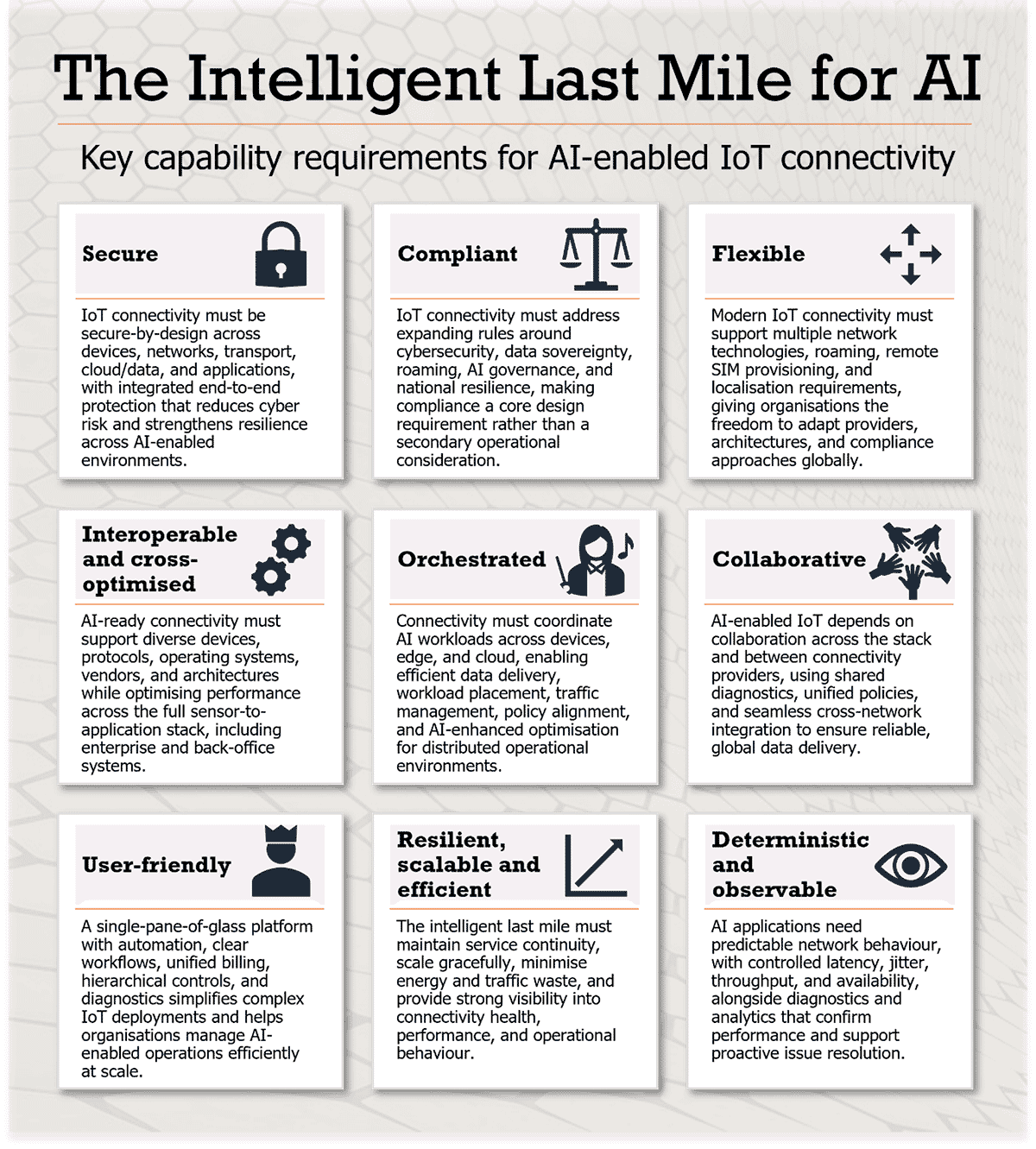
One aspect of that evolution is explored in a new report from Transforma Insights, sponsored by Tata Communication. ‘The Intelligent Last Mile: How networks must leverage AI to address the evolving needs of IoT’, looks at how the delivery of IoT connectivity needs to adapt to the demands of AI, to be ultra-efficient, compliant, secure, and flexible. The nine key characteristics of an IoT connectivity solution for supporting AI are as follows, as outlined in the report:
Secure-by-design – The best mechanism for addressing the growing security threat is to adopt a ‘Secure-by-Design’ approach which considers all elements of the IoT application holistically, as well as giving careful consideration of the overall approach to security.
Compliant – Regulatory compliance has long been part of IoT through device certification and safety requirements. However, as IoT increasingly supports critical infrastructure and sensitive applications, regulations are expanding in scope and complexity, particularly around security, data sovereignty, and AI. Compliance is therefore becoming a core element of IoT connectivity rather than a secondary concern.
Flexible – The mechanisms for delivering global (cellular-based) IoT connectivity have evolved significantly in the last decade, including the arrival of remote SIM provisioning for managing the connectivity, and the increasing availability of network technologies optimised for various aspects of IoT, including NB-IoT, LTE-M, and 5G Standalone (5G SA). The profusion of different technologies is certainly helpful for addressing the needs of IoT, but it does present some complexity. Ideally an IoT connectivity proposition should offer the full suite and the flexibility to select between them as appropriate for the customer.
Interoperable and cross-optimised – A truly holistic ‘last mile’ for AI incorporates a wide variety of deployment environments, including in-building, highly remote, and globally distributed. It also includes a highly heterogeneous fleet. The provision must be sufficiently interoperable to manage devices with a wide range of characteristics, device vendors and networks, including such capabilities as eSIM management. There is also an increasing focus on the cross-optimisation of the various functions of an IoT solution from sensor to gateway to network to cloud to application, considering factors such as power management, processing, AI model management, and cost.
Orchestrated – A next-generation connectivity proposition must be designed to support AI workloads that span devices, edge environments, and central cloud platforms. As applications depend on rapid decision cycles, richer contextual data, and increasing autonomy, the network becomes a key determinant of how information is transported and where computation takes place. Local inference often requires proximity to the data source to minimise latency and reduce transport overhead, while larger-scale training and aggregation continue to rely on central facilities. Supporting this distribution requires a connectivity layer that can deliver data efficiently and predictably across all tiers of the architecture.
Collaborative – An Intelligent Last Mile must increasingly support a more collaborative operating model because AI-driven systems depend on coordinated behaviour across the entire IoT stack. As data is collected, processed, and acted upon across devices, edge platforms, orchestration layers, and cloud environments, no single component can operate in isolation. Collaborative capabilities include shared diagnostics, open APIs, unified policy frameworks, and cooperative management models that improve data flow and overall service quality.
User-friendly – Another key facet of an IoT connectivity capability relates to its user-friendliness, given the complexity of deployments. A unified experience built around a single-pane-of-glass (SPOG) platform allows users to manage devices, connectivity, policies, and AI-related data paths from one environment, reducing friction and the risk of configuration errors. Centralised billing, consolidated support channels, and unified fault resolution simplify administration by removing the need to navigate multiple suppliers or interfaces. Hierarchical management, intuitive interfaces, automated provisioning, data visualisation and other features all help increase the user-friendliness.
Resilient, scalable and efficient – An intelligent last mile must tolerate network disruptions, variable signal quality, and hardware faults through built-in resilience mechanisms. Furthermore, as device fleets grow and AI models demand richer data, the connectivity layer, including particularly the underlying Connectivity Management Platform, must scale without introducing delays or congestion.
Deterministic and observable – AI applications often depend on predictable behaviour from the network. Deterministic performance requires tight control over latency, jitter, throughput, and availability. Features such as prioritised traffic classes and deterministic scheduling enable devices to deliver data within defined bounds, supporting real-time inference and reliable actuation.
The post IoT connectivity for AI: The nine key characteristics of the ‘Intelligent Last Mile’ appeared first on IoT Business News.