
The US Virgin Islands Make the Jones Act’s Propane Problem Even Clearer
Last week, I wrote about Puerto Rico’s propane imports from the US mainland exploding once the Jones Act waiver made American supplies available for shipment via oceangoing tankers. In about four months, the island imported more than double the combined total shipped from the mainland during 2004–2025. The waiver, I argued, had turned a theoretical argument about the Jones Act’s harm to Puerto Rico’s energy supply into an empirical one.
Later that week, the Washington Post weighed in, and its July 23 editorial is worth a close look because (among other things) it adds something I didn’t: a comparison.
The Dominican Republic Contrast
The Post’s editorial board framed the absurdity plainly, noting that Puerto Rico, despite being part of the world’s largest propane-producing country, has spent years sourcing the fuel from often distant countries, not because of distance or price, but because no Jones Act-compliant ship for transporting bulk propane exists. As a result, the editorial board pointed out that Puerto Rico can’t buy large quantities of American propane.
This isn’t despite being part of the United States, but because Puerto Rico is part of the United States and thus subject to the Jones Act.
To help drive the point home, the Post did something I neglected to do: it contrasted Puerto Rico’s propane imports with those of the neighboring Dominican Republic. With no coastwise shipping law standing between it and the US mainland, the country imported over 12 million barrels of American propane in 2025. Puerto Rico imported 19,000.
It’s a 630-to‑1 ratio between two Caribbean markets, roughly 100 miles apart, separated mainly by the fact that one is subject to the Jones Act and the other isn’t.
Extending the Comparison: The US Virgin Islands
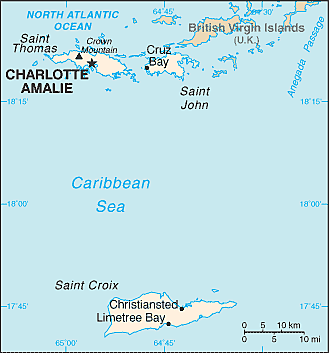
The Dominican Republic comparison is compelling, but there may be an even better one: the US Virgin Islands (USVI), which lie a similar distance in the opposite direction. Like Puerto Rico, the USVI are an American territory that consumes large quantities of propane. Unlike Puerto Rico, however, they are exempt from the Jones Act. This chart comparing each jurisdiction’s imports of US propane makes plain the law’s impact.
Last year, the USVI imported roughly 76 times more American propane than Puerto Rico did, at 1.3 million barrels versus 17,000. Zoom out across the full decade, and the pattern holds in every single year, with the USVI reliably importing hundreds of thousands to millions of barrels of US propane annually, while Puerto Rico’s totals sit in the single- and double-digit thousands. Add the Dominican Republic, and the picture is unambiguous. The two jurisdictions without Jones Act restrictions, one foreign and one domestic, both dwarf the one that is subject to the law.
What makes the USVI figures particularly striking is scale. The territory’s population is a small fraction of Puerto Rico’s, at approximately 1/30th its size. And the USVI’s propane imports are for domestic consumption, with liquefied petroleum gas (such as propane) accounting for 60 percent of the USVI’s electricity generation. Its substantial domestic demand for propane—including electricity generation that relies heavily on LPG—means these imports cannot be dismissed as reflecting a regional transshipment or distribution role (which would itself only be possible because of the USVI’s Jones Act exemption).
A jurisdiction with a tiny fraction of Puerto Rico’s population, importing substantial quantities for its own use, has nonetheless imported vastly more American propane than Puerto Rico, year after year, for a decade.
The Bottom Line
The Post’s editorial board deserves credit for putting numbers next to numbers and letting the comparison do the arguing. Extend that comparison to the USVI, and the conclusion only sharpens. Whether the yardstick is a foreign neighbor or an American territory, Puerto Rico offers a dramatic example of the Jones Act’s imposition, while the waiver shows what happens when that constraint is lifted. Congress should not need another data point to see the law’s harm and the overdue need for change.