
1NCE connectivity to support Pessl Instruments’ smart farming sensor network
1NCE is providing connectivity and device-management capabilities for Pessl Instruments’ METOS weather network, supporting thousands of weather stations and field sensors used by farmers in more than 80 countries.
Precision agriculture depends on a difficult combination of technologies: sensors must sit for long periods in remote fields, cellular coverage is often uneven, and the data only becomes useful if it reaches agronomic software at the right time. In that environment, connectivity is not a background utility. It is part of the farming system itself.
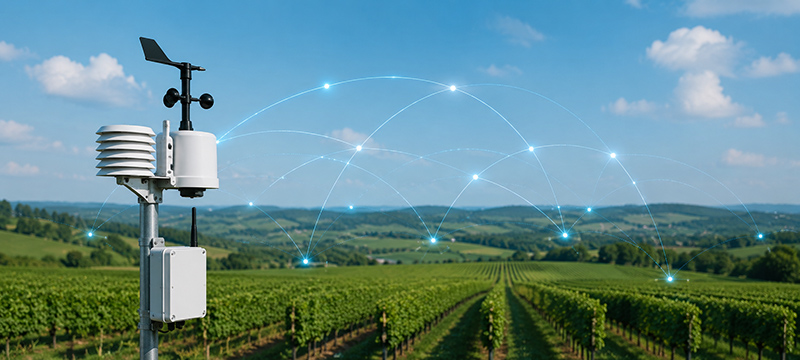
That is the context for the roll-out of the METOS by Pessl Instruments weather network solution powered by 1NCE. Pessl Instruments’ smart farming infrastructure collects field data including precipitation and soil moisture, and supports services such as extreme weather forecasting and crop disease risk information. 1NCE is supplying the global cellular connectivity service and platform layer used to connect and manage those deployments.
More than a SIM supply agreement
What makes this announcement distinct from many agricultural IoT connectivity deals is the combination of a named, field-proven smart farming network with platform-based device management. The emphasis is not simply on putting SIMs into sensors. Pessl Instruments is using 1NCE’s service to support weather stations across multiple national markets while monitoring devices through the 1NCE platform.
That matters because Pessl Instruments is already serving farmers in more than 80 countries, while 1NCE’s connectivity service is available in more than 170 countries across LTE-M, NB-IoT and 4G. For an agriculture equipment supplier, this kind of arrangement can reduce the need to manage separate connectivity contracts, local mobile operator integrations and country-by-country provisioning processes for each market. The practical benefit is commercial and operational as much as technical.
The companies state that the solution is delivered with 99.97% service availability. In agricultural IoT, that figure is relevant because the value of a weather station is tied to continuity. Missing data from a remote field may not just delay a dashboard update; it can reduce the usefulness of irrigation decisions, fertilizer planning or crop disease risk assessment at the moment when farmers are trying to act on local conditions.
The technology choices also reflect the constraints of rural deployments. LTE-M and NB-IoT are commonly used for low-power IoT applications, while 4G provides broader cellular availability in many markets. Using a mix of these cellular technologies gives deployment teams more flexibility, but it does not eliminate the basic dependency on local network coverage at the farm site. The announcement is therefore best understood as an effort to simplify global connectivity management, not as a guarantee that every rural location will be equally easy to connect.
For OEMs building agricultural devices, the partnership highlights the increasing importance of designing connectivity and lifecycle management into the product architecture from the start. A weather station deployed in one country may need to be sold, activated, monitored and supported in another without redesigning the communications model. That requirement is becoming more common as IoT hardware vendors move from national projects to repeatable international product lines.
For system integrators and agricultural enterprises, the significance is different. A unified connectivity platform can make it easier to keep track of distributed field assets and identify stations that are offline or underperforming. In a farming environment, where devices may be installed far from service teams, remote monitoring can directly affect maintenance planning and customer support costs.
Connectivity providers should also read the announcement as another example of how IoT value is shifting beyond basic network access. Pessl Instruments is not only looking for radio coverage; it also needs the operational layer to manage thousands of endpoints and keep data flowing into its smart farming services. That is where specialized IoT connectivity platforms are positioning themselves against conventional mobile connectivity offers.
The broader relevance is that agriculture remains one of the more demanding proving grounds for IoT infrastructure. Unlike factory or building deployments, smart farming networks must operate across dispersed land, variable coverage conditions and international markets. By tying METOS weather stations and field sensors to a global IoT connectivity platform, Pessl Instruments and 1NCE are addressing one of the less visible but critical barriers to scaling precision agriculture: keeping rural devices connected consistently enough for the data to be actionable.
The post 1NCE connectivity to support Pessl Instruments’ smart farming sensor network appeared first on IoT Business News.