
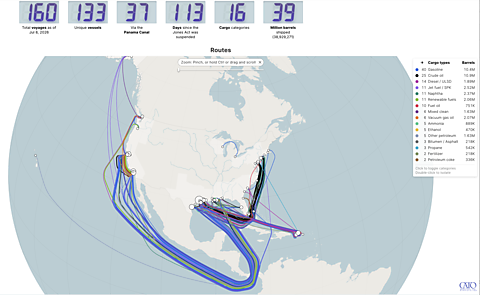
Since March, a Jones Act waiver for energy and fertilizer shipments has acted as a real-time experiment in what the country might look like without the law’s shipping restrictions. The results are noteworthy, including historically significant volumes of crude oil and petroleum products being moved to the West Coast from domestic sources, a surging appetite by Puerto Rico for American fuel, and the opening of new trade routes. It’s compelling evidence for the long-standing critique that the Jones Act functions as a barrier to domestic commerce.
But beyond its economic insights, the waiver is also producing additional evidence on the role of special interests in preserving the protectionist law. As I pointed out last year, the law’s concentrated benefits have produced an ecosystem that exerts near-constant pressure to maintain the Jones Act and thwart reform efforts, while those who bear its burden remain rationally ignorant and politically inactive. This is now playing out before us, with the waiver showing the machinery of Jones Act advocacy at work.
The Response
Unsurprisingly, Jones Act advocacy groups and the broader maritime lobby did not respond to the waiver quietly. In their attempt to end the law’s suspension, or at least prevent it from being further extended, these organizations have employed the full array of available tools.
Paid media: In May, the American Maritime Partnership (AMP) announced a national ad campaign opposing the waiver, including television, connected TV, radio, and digital advertising. Its lead ad has drawn approximately 440,000 YouTube views, and eight new clips—“End the Waiver,” “Talking Point,” “Republican Leaders Say End the Waiver” and their various versions—have so far pulled in over 3.2 million combined views. That’s substantial reach for a channel with 514 subscribers.
The American Waterways Operators (AWO), meanwhile, has produced its own series of ads against the waiver, including some specifically aimed at Louisiana (posted July 7), Kentucky (posted July 13), and Florida (posted July 23). AWO’s video descriptions indicate the ads as part of a 10-state campaign run in conjunction with AMP and the Transportation Institute, another pro-Jones Act advocacy group.
Manufactured grassroots: AMP’s ads conclude by spotlighting the website EndTheWaiver.com, which redirects to a form-letter generator to send to members of Congress. But this is far from the only effort to create a perception of grassroots opposition to the waiver.
In May, a number of social media accounts with large followings—none of whom had previously commented on the Jones Act—began expressing concerns about the waiver. Notably, two unrelated social media accounts—one by a singer and the other a lifestyle influencer—posted identical language one day apart about the Jones Act protecting “650,000 Americans.” One of the accounts disclosed that its post was part of a paid partnership.
In perhaps a similar spirit, an anti-waiver op-ed appeared under the byline of a fellow at Americans for Liberty and Security. Details about the group, which lacks a website, are sparse, but the author also carries the title of director of government affairs at a K Street firm that builds coalitions.
A flurry of bylines: The previously mentioned piece is just one of at least seventeen op-eds and letters to the editor defending the Jones Act that have appeared in national and regional outlets since the waiver took effect. That’s nearly one per week since the first item was published in late March, and is an undercount if any were missed in my canvassing.
Few of the authors are disinterested observers. William P. Doyle, who serves as CEO of the Dredging Contractors of America and is an AMP board member, wrote two op-eds and a letter to the editor. Other authors include the head of AMP (op-ed, letter to the editor), a Seafarers International Union official, the head of another maritime industry group, and the Transportation Institute’s chairman.
Questionable studies: While AMP and AWO produce ads, the Transportation Institute has been actively producing various studies and analyses critical of the waiver. Most recently, the group commissioned a study that found a long-term Jones Act waiver would put over 100,000 jobs “at risk.” Beyond a lack of clarity about what that means, the study explicitly did not model an extension of the current waiver, but rather a hypothetical, far broader suspension of the law for an undefined period. Yet despite these profound differences, the study is still being deployed against an extension of the current waiver.
Separately, the Transportation Institute has published flawed graphics claiming the waiver has added little tanker capacity and no new trade routes (curiously, the graphics also listed four specific new routes the waiver had opened). It also released another graphic alleging the danger to American infrastructure from foreign ships operating under the waiver, but appears to have since removed it.

What Can’t Be Seen
The above is merely what’s visible and does not include lobbying efforts that continue behind the scenes. On July 16, AWO disclosed that both it and AMP had been engaged in “intense behind-the-scenes advocacy” ahead of the Trump administration’s decision about extending the current waiver.
Such efforts may be bearing fruit. In late June, fifty-two House Republicans, including the Speaker and Majority Leader, wrote a letter to the White House urging it to let the waiver expire. Six weeks earlier, two House Democrats sent their own letter demanding the administration justify every voyage. Plainly, lobbyists engage in lobbying because the rewards outweigh the costs, and such letters don’t write themselves.
Concentrated Benefits, Diffuse Costs
All of this is rational behavior by a group with a direct financial stake in the outcome. Similarly rational is the lack of a commensurate response by those who suffer the Jones Act’s costs (to be clear, there are almost certainly lobbying and advocacy efforts in favor of the waiver’s extension, but nothing on par with that of the maritime industry). It’s the predictable outcome of the asymmetry in protectionism’s costs and benefits.
Importantly, this full-spectrum response was elicited by a waiver limited to energy and fertilizer products. Now imagine the resources that would be deployed if a credible effort were developed to repeal or significantly reform the law.
Where This Leaves Things
As of this writing, the White House appears set to extend the waiver again, possibly in a narrower form than currently. Nothing is final, and the industry campaign cataloged above is presumably aimed at ensuring that. If the waiver endures, it won’t be because of the opponents’ lack of effort.