
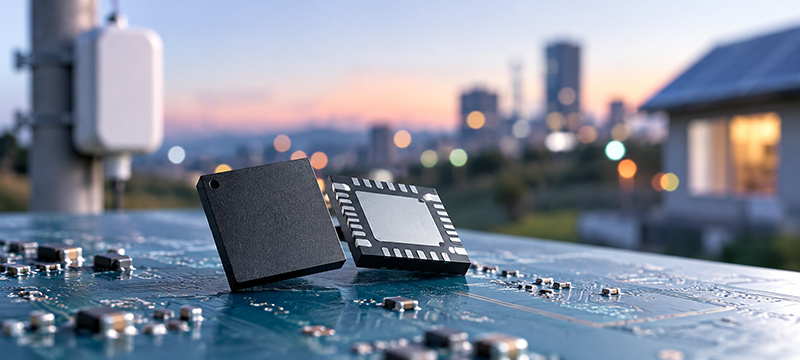
Semtech Moves LR2022 and LR2012 LoRa Plus Devices Into Production
Semtech says its LR2022 and LR2012 devices are now in production, extending the company’s LoRa Plus family from announcement stage into a more concrete phase for OEM design and sourcing decisions.
For low-power IoT product teams, radio selection is rarely just a matter of range or power consumption. The more immediate constraint is often availability: whether a component has moved beyond sampling, whether it can be designed into a commercial product with acceptable risk, and whether the surrounding ecosystem is mature enough to support certification, integration and manufacturing schedules.
That is the practical context for Semtech’s latest LoRa-related update. The company has expanded its LoRa Plus family with two devices, the LR2022 and LR2012, and says both are now in production. The announcement is not a deployment win, a network rollout or a new LoRaWAN service. Its significance lies further upstream, at the semiconductor level, where component availability can shape the timing and architecture of IoT devices years before those devices appear in the field.
The detail that matters most is the “now in production” statement. In the wireless module and embedded device market, that status changes the nature of the conversation for OEMs. A chip that is presented as a future roadmap item invites experimentation; a chip in production can be considered for product planning, supply-chain engagement and engineering validation. That does not remove the need for qualification, certification work or board-level integration, but it does make the LR2022 and LR2012 more relevant to teams moving from concept to commercial design.
Why production status matters for LoRa-based IoT design
LoRa and LoRaWAN occupy a particular place in the IoT connectivity landscape: they are commonly considered where long battery life, long-range communication and relatively small payloads are part of the design brief. In those environments, small changes at the radio level can have implications across antenna design, firmware work, bill of materials planning and gateway or network compatibility testing. Even without additional specifications disclosed here, the introduction of two production devices gives engineering teams more concrete options to evaluate inside the LoRa Plus family.
Connectivity providers and system integrators should view the update differently. They are unlikely to be directly affected by the availability of a chip alone unless it appears in commercial devices or modules they support. However, a broader production silicon family can influence the diversity of endpoints that later connect to private or public LoRaWAN networks. For integrators working on utilities, smart buildings, asset monitoring or industrial telemetry, the device ecosystem is often the limiting factor once coverage and network management are in place.
For enterprises and industrial players, the immediate impact is indirect. The LR2022 and LR2012 do not, by themselves, solve deployment challenges but production availability at the component level is one of the early signals that future device designs may have more LoRa Plus-based options to choose from.
In a market where many IoT announcements focus on platforms, dashboards and services, Semtech’s update is a reminder that the foundations of large-scale IoT still begin with embedded hardware. The move of the LR2022 and LR2012 into production gives the LoRa Plus family a firmer footing for OEM evaluation, while leaving the more important proof points—design wins, certifications and field deployments—to be demonstrated later.
The post Semtech Moves LR2022 and LR2012 LoRa Plus Devices Into Production appeared first on IoT Business News.