
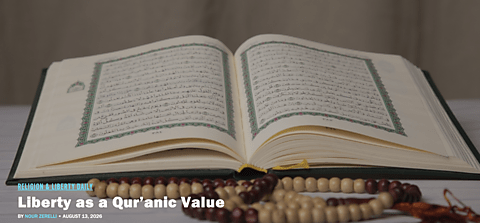
Religion & Liberty, a publication of the Acton Institute, published an insightful review of our edited book, No Compulsion in Religion—No Exceptions: Islamic Arguments for Religious Freedom. Penned by Nour Zerelli, a PhD student in Islamic intellectual history at the University of Massachusetts-Amherst, the piece aptly summarized the book’s key message—one also captured in its title: “Liberty as a Qur’anic Value.”
Zerelli first summarized the gist of the book:
“How can a true and just God command coercion? That is the burning question that lies at the heart of Muslim consciousness and that a new book proposes to address. The explicit tension between what we’d like to think is the answer and what we fear is the answer makes many, especially those raised culturally Muslim, hesitant even to ask such a legitimate question aloud. It sits beside another unsettling anxiety, that of wondering if faith compelled is faith at all.
“The Qur’an responds in a concise sentence: ‘There is no compulsion in religion.’ What follows immediately in Q 2:256, qad tabayyana al-rushd min al-ghayy (‘Truth stands out clear from error’), confirms this fundamental principle as it carries the logical weight of the argument. Revelation drew the line between the path of guidance and the path of misguidance. It falls entirely to the individual to decide which path to follow. After all, it is absurd to speak of accountability in the absence of freedom.
“Against this backdrop, No Compulsion in Religion—No Exceptions, a volume of essays by Muslim scholars edited by Mustafa Akyol, takes that foundational verse as its title, its thesis, and its challenge—a verse, it should be noted, that some early medieval exegetes had considered annulled. Yet, as Akyol states in the introduction, ‘this magnanimous maxim … should be applied, in other words, in all respects, and with no exceptions.’ The phrase ‘no exceptions’ is the reform that the book proposes to bring and that might ignite controversies, because the exceptions are precisely what a portion of the tradition accumulated.”
Going through the chapters, Zerelli observed a “remarkable spectrum”: “Mustafa Akyol’s chapter on a militant purifying movement in the 17th-century Ottoman Empire, Abdullah Saeed on the criminalization of apostasy, Husnul Amin on blasphemy laws in Pakistan and beyond, Mohamed Lamallam on Ramadan laws, Mohamad Machine-Chian on how compulsion made Iran less religious, Asma Afsaruddin on women, and a closing conversation with the legal scholar Abdullahi Ahmed An-Naʿim on separating Sharia law from the state.” Then she noted why these arguments are timely:
“The book’s urgency comes from lived realities that are shaping Muslim faith, fate, and thought. Across the Muslim world, coercive laws continue to emerge in the name of defending religion. Freedom of conscience collapses the moment that the frontline of religion becomes apostasy punishments in several majority-Muslim states, blasphemy laws in Pakistan, morality policing in Iran, and gender restrictions in Afghanistan.
“Building on this tension, the volume argues against grounding any concept of coercion in Islamic teaching and addresses a diverse audience. It speaks to Muslims uncertain about what to think and who to follow, but also to Western critics of Islam. It also challenges those who manufactured a binary opposition between Islam and reason, Islam and freedom, Islam and progress, and Islam and the West.”
“The book,” the author added, “is also an invitation to ijtihād, critical thinking, and reinterpretation, all while successfully being an example of it.” You can read it all here at Religion & Liberty Daily.