
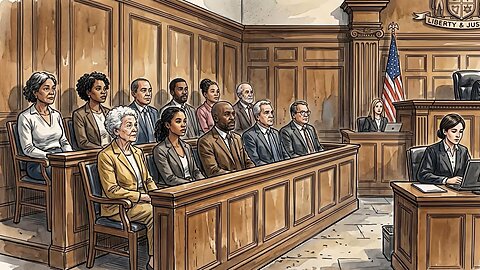
This fall, the Cato Institute launched Your Verdict Counts, a nonpartisan civic education campaign. It is meant to educate the public about how the jury is the most direct form of democratic power ordinary people hold. This power arises from the often overlooked, and sometimes controversial, prerogative of jurors to acquit defendants in criminal cases based on concerns about injustice. The Constitution guarantees trial by jury as a way of preventing oppression. Juries can only serve that role if they ameliorate unjust laws by acquitting those accused of violating them—a task jurors have done at crucial points in American history, including the struggles against slavery and Prohibition.
Some critics have expressed concern that Your Verdict Counts urges jurors to violate the oaths they swear when they begin to serve. This is simply not true. First, and most importantly, nothing in any of our materials—which include a dedicated website, a documentary video, and public communications—in any way urges or suggests to prospective jurors that they should violate any oath they may be required to take as a condition of jury service or that they should take such an oath in bad faith, with their fingers figuratively (or literally) crossed behind their backs.
Furthermore, Cato has surveyed the language of juror oaths for criminal cases in the federal system, every state, and the District of Columbia. Of these 52 jurisdictions:
Nine do not have a standard oath.
Four require jurors to decide the case based on the law as “given” or “presented” at trial, without specifying how that law is delivered. These do not name the judge as the exclusive interpreter of the law.
Twenty-eight require jurors to render a verdict according to either “the law and the evidence” (as in the model federal oath) or just the evidence. While a number of these jurisdictions also have model jury charges telling jurors to follow the judge’s legal instructions, this is not part of the oaths that jurors swear.
Eleven specifically mention the role of the court or its instructions in defining the law.
Beginning with the majority block containing 28 jurisdictions, the oath nowhere commits the jury to following the judge’s legal instructions. Moreover, a verdict accords with the law if it reflects the responsibilities entrusted to jurors by the Constitution. The Constitution is law, of course. And as a matter of originalism, juries determined the law in criminal cases during the Founding era. The text of the oath, the constitutional backdrop, and the history of trial by jury all support jury independence as compatible with what a juror has sworn to do. And an instruction to decide the case based on the evidence facially constrains the jury from considering facts not admitted into evidence. Where it is silent as to the law, it does not facially regulate how jurors are to receive and respond to it.
Turning to the four jurisdictions specifying that the jury is to decide the case according to the law given at trial, this is not the same as requiring jurors to treat the judge’s instructions as conclusive. For instance, New Hampshire binds jurors only to “carefully consider … the law presented to you in this case.” This oath does not mention the judge’s role, and historically in that state as elsewhere, jurors would have weighed competing understandings of the law. (New Hampshire actually goes further and statutorily provides that “the court shall permit the defense to inform the jury of its right to judge the facts and the application of the law in relation to the facts in controversy,” though the state supreme court has effectively disabled this provision.) In light of legal history and the generality of their language, this class of oaths is compatible with jury independence as Your Verdict Counts frames it.
That leaves 11 jurisdictions where the jurors’ oath includes applying the law as delivered by the judge. This does not necessarily exclude jury independence as Your Verdict Counts presents that principle. The law as given by the judge may authorize the jury to acquit a factually guilty defendant. In the Georgia courts where I was a public defender, jurors are often told that they “may” convict a factually guilty defendant, whereas they “must” acquit if the prosecution failed to prove guilt beyond a reasonable doubt. Thus, a juror could follow Your Verdict Counts’ invitation while fully complying with the judge’s legal charge. (Georgia is not one of the 11 jurisdictions with the sort of oath in this block, but that is beside this point—particular attention to what the judge actually tells the jury about the law is important anywhere.)
As for the true hard cases in which an oath purports to strictly bind the jury to robotically apply the facts they have found to be proven beyond a reasonable doubt to the law as given to them by the judge, the understanding of the Constitution reflected in Your Verdict Counts is that this is unconstitutional, as my colleague Mike Fox and I explain in a forthcoming law review article. For now, it suffices to note the obvious fact that there are limits to what a judge may properly require prospective jurors to agree to as a condition of jury service: agreeing to credit the testimony of one race (or gender) over another, for example, or to apply a less exacting standard than proof beyond a reasonable doubt (which appears nowhere in the text of the Constitution and yet—like juror independence—was understood by the Founders to be a bedrock feature of criminal adjudication in our system).
Our good-faith constitutional interpretation notwithstanding, Your Verdict Counts tells prospective jurors to “be honest” about their “beliefs and values.” We oppose perjury, and should a juror be unable to adhere to the oath—even a lawless oath that the judge has no legitimate constitutional power to mandate—he or she should tell the judge and seek to have the oath changed through the legal or political process.
There may be a narrow set of juror oaths that require this course of action. But the great majority of those prescribed by law comport with the trial by jury guaranteed by the Constitution. They allow jurors to check oppression by acquitting in the name of justice.