
Verizon and Bosch Motorsport Expand IoT Connectivity for Global Race Telemetry
Verizon Business and Bosch Motorsport are extending their collaboration to support real-time race telemetry and regulatory compliance monitoring across international motorsport events, leveraging eSIM technology and centralized IoT connectivity management.
In professional motorsport, reliable access to vehicle telemetry is essential not only for performance monitoring but also for enforcing technical regulations and maintaining track safety. Delivering that data consistently becomes particularly challenging when racing operations move between countries, mobile networks and venues with thousands of connected spectators.
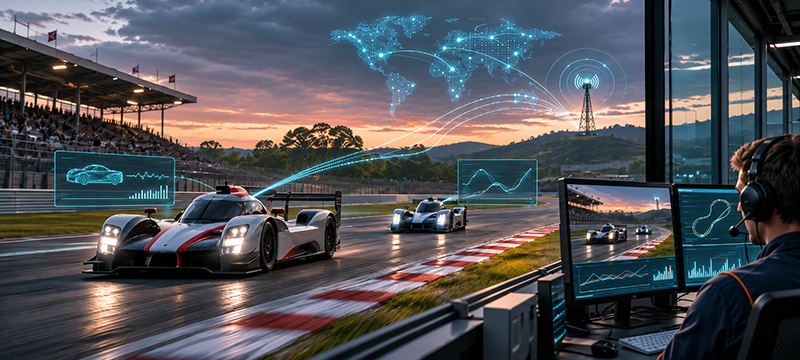
Verizon Business and Bosch Motorsport are addressing these challenges through a global IoT connectivity deployment designed to support Bosch’s RaceConnect sensor systems at international racing events.
Following an initial deployment at the Detroit Grand Prix and subsequent use at Motul Petit Le Mans, Bosch Motorsport is extending the solution to additional domestic and international races, including events in the IMSA WeatherTech SportsCar Championship.
Centralized connectivity across international racing venues
The deployment combines Verizon Global IoT Orchestration with its ThingSpace connectivity management platform, allowing Bosch Motorsport to manage connected devices across multiple countries without having to reconfigure their network access settings for each local operator.
At the center of the architecture is a unified Access Point Name (APN), which remains consistent as devices connect to supported mobile networks in different countries.
Verizon’s platform supports connectivity in more than 140 countries, using remotely provisioned eSIM profiles to connect compatible devices to local networks. This enables Bosch to maintain a common connectivity configuration while managing its international sensor fleet through a single interface.
The approach is particularly relevant for motorsport operations, where equipment must be transported, installed and brought online repeatedly across different venues and telecommunications environments.
Rather than treating each racing event as a separate connectivity deployment, Bosch can maintain a standardized device configuration and management process across its international operations.
For IoT solution providers, this illustrates an important operational benefit of eSIM-based connectivity orchestration: reducing the need for country-specific network configurations can simplify device preparation, testing and deployment logistics.
From racecar sensors to cloud-based intelligence
Bosch’s RaceConnect system collects operational and condition data from sensors installed in racing vehicles. This information is transmitted to the Bosch RaceConnect private cloud, where it supports technical compliance checks, performance monitoring and race safety procedures.
These functions form part of digital race marshalling, which increasingly relies on connected sensors and near-real-time data processing rather than exclusively on manual observations and trackside inspections.
The technical requirements are demanding. Racing vehicles can exceed 320 km/h, while telemetry must remain available to officials and engineering teams throughout an event.
Through ThingSpace APIs, Bosch can manage connected devices throughout their operational lifecycle, including activation and suspension, while maintaining centralized visibility over its sensor fleet.
The distinction between this deployment and a conventional connected-vehicle application lies in its combination of mobile telemetry, international network orchestration and event-specific connectivity infrastructure.
Unlike a typical fleet telematics installation, the operating environment changes from one event to another, and the network must accommodate both moving vehicles and concentrated demand from spectators.
Private mobile infrastructure supports race-day reliability
During the Detroit Grand Prix, Verizon deployed additional mobile network infrastructure to support Bosch Motorsport’s telemetry requirements.
This included Cells on Wheels (COWs), Cells on Light Trucks (COLTs), Distributed Antenna Systems (DAS) and a Mobile Private Network.
The objective was to separate critical telemetry traffic from spectator connectivity, reducing exposure to congestion during the event.
According to Verizon, the deployment enabled race officials to access data for rules enforcement while engineering teams could use telemetry to make mechanical adjustments during racing operations.
This combination of global IoT orchestration and dedicated local connectivity highlights an architectural consideration: centralized SIM and device management can simplify international operations, but it does not eliminate the need to address network capacity and reliability at individual deployment sites.
For other industrial IoT applications involving temporary installations, mobile equipment or high-density environments, the same distinction between global connectivity management and local network performance remains relevant.
A practical example of globally managed IoT deployments
Bosch Motorsport has already used the solution at Motul Petit Le Mans and plans further deployments at events including the Rolex 24 At Daytona and Mobil 1 Twelve Hours of Sebring.
Beyond motorsport, the project demonstrates how globally orchestrated cellular connectivity can support equipment that moves frequently between countries while requiring consistent operational oversight.
For OEMs and system integrators, the potential benefit is less about the underlying radio technology than about simplifying device configuration, connectivity provisioning and lifecycle management across geographically distributed installations.
However, the announcement does not provide quantitative telemetry performance results, network availability measurements or comparative data on operational cost reductions.
The significance of the Bosch deployment therefore lies primarily in its demonstrated operating model: combining eSIM-based international connectivity, centralized device management and dedicated on-site network resources to support demanding mobile IoT applications.
The post Verizon and Bosch Motorsport Expand IoT Connectivity for Global Race Telemetry appeared first on IoT Business News.