
IoT Data Analytics Explained: Collection, Integration and Value
Connected devices generate streams of information, but collecting readings alone does not create business value. IoT data analytics turns operational signals into insights that support faster decisions, better resource allocation, and more reliable equipment. From manufacturing and logistics to energy management, companies need systems that connect sensor data, process it efficiently, and translate patterns into actions. The challenge lies in building a reliable data flow that supports measurable operational improvements.
IoT data analytics: key insights for connected operations and processes
IoT data analytics turns connected-device readings into operational insights that serve as a base for forecasting, monitoring, and informed business decisions in general.
Edge computing is a method that reduces unnecessary data transmission to centralized infrastructure by processing relevant information closer to devices.
Effective integration links sensor readings to enterprise systems, bringing in external information and historical records as needed.
Organizations use predictive maintenance, smart metering, and fleet monitoring to identify inefficiencies and improve asset utilization.
Reliable results depend on a combination of factors, including data quality, scalable architecture, suitable analytics methods, and measurable performance indicators.
How IoT data analytics turns sensor readings into business decisions
Analysis begins as soon as connected devices start measuring physical conditions, including but not limited to:
temperature;
vibration;
energy consumption;
pressure;
machine activity.
These readings may arrive periodically, continuously, or only under specific conditions.
IoT Analytics reported that the number of connected IoT devices reached 18.5 billion globally in 2024, growing by 12% year over year. Such scale increases the importance of architectures capable of processing, organizing, and interpreting data efficiently.
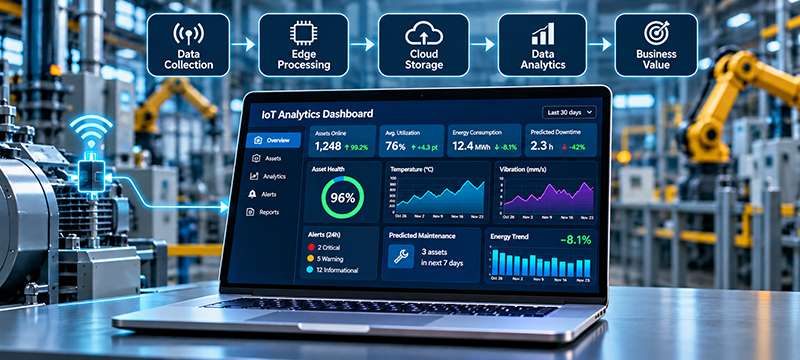
A typical IoT data analytics architecture moves information through several stages: collection, transmission, processing, storage, analysis, and visualization. Gateways and device software filter readings, while a data pipeline transfers information into analytical environments. Some processing happens locally through edge computing, while more demanding workloads run on a cloud platform.
How IoT data collection moves information from sensors to platforms
Collection architecture relies on the following factors:
connectivity;
latency;
bandwidth;
device capabilities.
For example, industrial equipment may transmit temperature or vibration readings through gateways, whereas vehicles provide information on speed, location, and fuel consumption rate. It is possible to set up a continuous stream of data. It can also be transferred in scheduled batches or via event-triggered messages.
Edge processing acts like a filter that parses, cleans, and organizes the raw data before it’s transmitted off-site. This saves bandwidth and money, especially when devices are taking measurements multiple times a second. Meanwhile, cloud infrastructure remains the best solution to safely store all that cleaned-up data long-term for further analysis and comparison.
Why IoT data integration combines operational and external context
Integration puts sensor readings into context using additional data from sources like:
inventory databases;
weather services;
traffic feeds;
ERP platforms;
market reports;
maintenance records.
For example, energy consumption becomes more meaningful when compared with electricity prices, production schedules, and weather conditions. Fleet performance can be assessed alongside traffic, route conditions, fuel prices, and delivery requirements.
Teams can enrich their sensor datasets by collecting related supplier tariffs, forecasts, prices, and market indicators that are publicly available online. To achieve the necessary stability for performing such operations at scale, proxy residential connections often become part of the infrastructure. Here are a few uses for the resulting datasets:
logistics planning;
smart metering;
operational benchmarking;
demand forecasting.
Which analytics methods support monitoring and predictive decisions
One can say analytics exists in three dimensions:
Descriptive analytics summarizes events via performance reports, dashboards, and historical trends.
Real-time analytics processes incoming information as it arrives and triggers immediate alerts and automated responses.
Predictive models, meanwhile, estimate future conditions based on existing readings and patterns.
Depending on the type of analytics and the business objective, the following methods may be used:
anomaly detection;
regression;
classification;
time-series forecasting.
A 2023 OECD analysis reported that IoT adoption in manufacturing averaged 31% among surveyed enterprises across European countries, while energy-sector adoption averaged 47%. The same analysis found that only 3.2% of enterprises in manufacturing and energy used data from smart devices or sensors for big data analytics, highlighting the gap between device deployment and analytical use.
Where IoT analytics creates measurable operational value
Applications differ by industry, but the business objective usually involves reducing waste, improving reliability, increasing visibility, or making decisions sooner.
In manufacturing, for example, equipment monitoring identifies harmful vibration, temperature changes, and resulting performance degradation early, cutting down on maintenance-related delays. To understand how costly broken schedules can get, refer to the 2023 IoT Analytics market report that estimates unplanned downtime median costs across 11 industries at roughly $125,000 per hour.
In logistics, fleet telematics is responsible for data on location, vehicle condition, routes, and fuel consumption. Thanks to analysis, you can identify inefficient approaches to fleet management, excessive downtime, and other problems.
Energy providers use smart metering to monitor consumption patterns, identify anomalies, balance demand, and improve billing accuracy. A digital twin can combine real-world measurements with a virtual representation of an asset or process, helping engineers compare actual performance against expected behavior.
How teams solve data quality, latency, and compatibility problems
Poor data quality can ruin any analysis. Problems are possible with timestamps, sensors, and gaps due to connectivity interruptions. Equipment from different manufacturers can use incompatible formats. All of this leads to erroneous forecasts.
Organizations should establish validation rules, monitor data completeness, standardize measurement units, synchronize timestamps, and document device configurations. Interoperability standards and carefully designed interfaces reduce integration difficulties, while access controls and encryption help protect operational information. Edge processing can also reduce latency where decisions cannot wait for cloud round trips.
How organizations evaluate the business value of IoT analytics
You cannot evaluate the return on IoT data analytics by technical performance alone. You need the full picture; you need to link analytical results to measurable indicators. You should take into account the frequency of downtime, maintenance costs, energy consumption, asset utilization, and other related factors.
A baseline should be recorded before deployment, followed by comparisons across equivalent periods or operations. Teams should account for implementation costs, connectivity, infrastructure, data engineering, model maintenance, and staff time. Benefits may vary depending on asset criticality, operating conditions, and the accuracy of analytical recommendations.
The most successful deployments begin with a defined operational problem, reliable measurements, and a decision that can be improved. When collection, integration, processing, and analysis work together, IoT data becomes a foundation for continuous operational improvement rather than a stream of disconnected readings.
Frequently asked questions about IoT data analytics applications
Answers to popular questions about IoT data analytics.
What is IoT data analytics in relation to industrial environments?
IoT data analytics examines information collected from connected devices, machinery, sensors, and industrial systems. It helps organizations monitor operating conditions, identify abnormal behavior, evaluate historical performance, and predict potential problems. Depending on the application, analysis can run locally, in the cloud, or across both environments to support maintenance, automation, energy efficiency, and operational planning.
How is IoT data integration able to improve business decisions?
Integration connects sensor readings with information from business systems, historical records, and external datasets. Additional context helps explain why operational patterns occur and supports more accurate decisions. For example, combining energy readings with tariffs or production schedules can reveal when consumption is unnecessarily expensive and where adjustments may reduce operating costs.
Which industries can benefit the most from IoT data management?
Manufacturing, transportation, logistics, energy, agriculture, and healthcare benefit from connected monitoring and structured data management. Industrial companies track machine performance, fleet operators monitor vehicles, and utilities analyze consumption. The value depends on whether data is sufficiently reliable, accessible, and relevant to a business process that can be improved.
What issues and challenges arise during IoT data analytics implementation?
Among typical problems, specialists note a lack of alignment in formats, device incompatibility, and the likelihood of a cyberattack. Storage requirements constantly grow. Sometimes, when working with data, a delay can occur because of connectivity. A business needs analytical skills and responsibility for working with such information. IoT projects become more reliable if you address the relevant issues at the early stages.
The post IoT Data Analytics Explained: Collection, Integration and Value appeared first on IoT Business News.