
Industrial IoT keeps optimizing for richer data when the real constraint is how many machines you can reach. FourJaw gave up the rich data on purpose, and the friction they hit next had nothing to do with sensors at all.
At the Advanced Manufacturing Research Centre in Sheffield, a project once put roughly a thousand sensors on a single CNC machine. It was called The Full Monty, which tells you the team knew exactly what they were doing.
Instrumenting everything is the correct approach for research, where you are optimizing for discovery and cannot know which signal will matter. It is close to the worst available instinct for product development, and a great deal of industrial IoT is still built on it.
Two engineers from that world founded FourJaw Manufacturing Analytics, and their first product did precisely what the industry recommends. They connected to CNC controllers and pulled data straight out of the machine. They captured enough information to reverse-engineer a finished part from its coordinates. Then they took that approach into real factories and quickly discovered the reality was very different.
As Chris Iveson, FourJaw’s CEO and co-founder recalls, customers would tell them, “We can do those three machines. We cannot do those over there; they are too old. That one is Japanese, and we have never seen one before.”
Every install had turned into a project. When they asked customers what all that rich data was actually for, the answer came back in one sentence. According to Iveson it was, “I just want to know when it’s making me money.”
The arithmetic nobody does
The value of an industrial data point has less to do with its resolution than with how many machines you can realistically get it onto. Those two things pull against each other more than most roadmaps admit. The industry spends nearly all its effort on resolution, which is why so many programs look impressive across four machines and quietly die around forty.
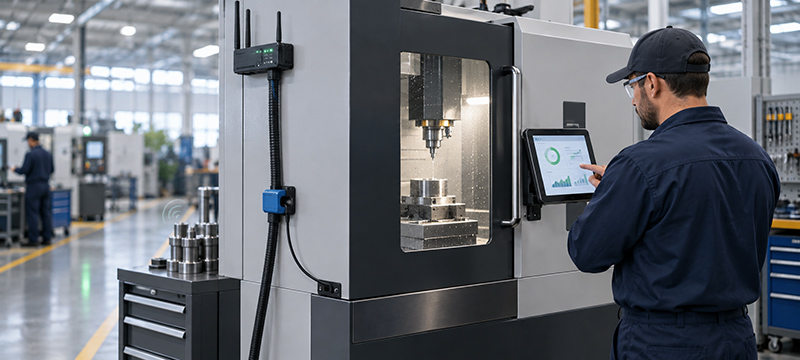
FourJaw’s response was a retreat that turned into a strategy. They abandoned controller integration and clamped a current sensor onto the outside of the machine, since production machines draw more power working than when idle. That signal will never tell you an exact error code, but it answers the question the customer asked: whether the machine is earning its floor space.
What they got in exchange fits any machine regardless of age, brand, or origin, installed by the customer in minutes. A multimillion-pound CNC machine and an office kettle look identical to the platform, and the kettle was genuinely the first thing they monitored. They traded fidelity for reach. A tradeoff can be hard to embrace because giving up data feels like giving up ambition.
The signal no sensor can produce
A perfectly instrumented machine still cannot produce the most valuable data point in the building. It knows that it stopped and has no idea why, because the reason is usually not machine-related. The operator went looking for a tool. The material arrived late. It was being reconfigured, behaving exactly as designed.
FourJaw collects that from a tablet mounted in front of the operator, who taps a reason when the line goes quiet. The cheapest component in the architecture produces the input that makes every other measurement actionable, and no sensor count reaches it another way. Power draw earns its place as the trigger rather than the insight, telling you to go ask a human while they still remember the answer.
Friction is the real ceiling
If coverage is the goal, friction is what stands in front of it, and it arrives in layers.
Integration friction is the layer everyone can see, and FourJaw handled it by walking away from the controller. Install friction is the next, and it never shows up on an invoice: any deployment needing a site visit carries a per-site human cost that multiplies against fleet size, which is how a software margin quietly becomes a services business.
The layer almost nobody prices is the network.
FourJaw’s early installs ran over customer Wi-Fi, the default shortcut in industrial IoT, and it holds up until an enterprise customer has policies. Corporate IT security sometimes blocks NTP, and without accurate timestamps, your time-series data is useless. Aerospace and defense sites frequently will not permit a third-party device on the network at all. Some factory floors have no Wi-Fi whatsoever, because the plant runs on paper and clipboards.
Then there is the failure that costs the most. The customer’s IT team has run out of things to try on their network, the vendor has run out of things to try on their device, both are honest, and nobody can prove anything while the customer watches two suppliers shrug at each other.
FourJaw stopped negotiating for access to networks they would never be allowed to change, and now ship cellular routers with a global SIM provisioned and configured. Bandwidth had nothing to do with it, since five to seven megabits carries their fleet without strain. What they gained with a move to cellular was a connection they could control and remotely troubleshoot themselves, removing the risk of finger-pointing.
The objection you have not been asked yet
The thing that kills an already installed system is rarely a competitor, especially in larger enterprise deployments. It is a new CISO, an ISO certification, or a contract clause arriving eighteen months later and quietly prohibiting what is already in the building. Chris Iveson, FourJaw’s CEO, put the customer side of it plainly: “they don’t really want us on their network.” Sensor data is company data, and it has to comply with corporate data policy like anything else.
The standard vendor response is to argue the merits. Machine uptime data is not sensitive. The machine is running or it is not. Why does that need a private network?
That argument is usually correct and completely useless. Corporate security policy is a blanket, not a threat model. The person enforcing it is not evaluating your data, they are enforcing a rule and telling them their rule does not apply to you is a debate you will lose in a procurement meeting while sounding smug.
The better answer is to stop arguing and produce a price.
If devices use SIMs from a cloud-native carrier, data routing is just software, so keeping traffic off the public internet becomes a configuration change rather than an engineering project. For example, FourJaw uses Soracom, allowing SIMs in the field to be remotely added to a Virtual Private Gateway service, carrying fleet traffic on an isolated secure path into the cloud via AWS Transit Gateway or VPC peering. No site visit, no hardware change, nobody opening a panel on a running machine.
An objection you cannot answer costs you the account. One with a configuration change and a monthly figure attached is just procurement.
The better question
The industry keeps asking what else we could measure, which is the wrong question. Although it does win planning meetings on enthusiasm alone. The question that decides whether a program survives contact with the real world is narrower and far less entertaining.
What can we measure on machine number four hundred, installed by somebody we will never meet, in a building we will never visit, on a network we are not allowed to touch, under a security policy nobody has written yet?
You can do a lot more with less in the IoT space when the plan is to reduce complexity, not add to it.
Source: Quotations and account of FourJaw’s product history are drawn from an interview with Chris Iveson, CEO and co-founder of FourJaw Manufacturing Analytics, on the podcast What to Expect When You’re Connecting, episode “The Fitness Tracker for Your Machines: How FourJaw is Rewiring Factory Productivity,” published August 19, 2026.
The post The best data point in the factory doesn’t come from a sensor appeared first on IoT Business News.