
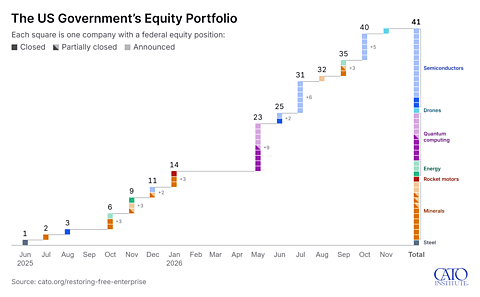
President Trump wanted his own sovereign wealth fund. When the White House realized it would require congressional action, the administration went ahead and started building an ad hoc portfolio anyway, one deal at a time. Section 1051 of the Senate’s fiscal year 2027 National Defense Authorization Act would reward the administration for its opaque and legally dubious equity operation. It would give the Pentagon’s Office of Strategic Capital a dedicated account and express authority through 2037 to buy stakes in suppliers of critical minerals, materials, chemicals, and batteries.
Douglas Holtz-Eakin, former Congressional Budget Office chief and president of the American Action Forum, put his finger on the problem this week: If the Pentagon owns stock in one supplier and a competitor offers the military a better price, who gets the contract? Today, Holtz-Eakin joined an ideologically and politically diverse coalition of advocacy organizations in urging the House and Senate Armed Services Committees to drop the proposal.
Their letter gets to the heart of the problem with Washington becoming a corporate shareholder:
Whether through executive action or congressional sanction, continued federal investment in private companies is deeply troubling and sets a dangerous precedent for the future in which the full force of government ownership could be used to execute partisan, moral, or philosophical agendas in the marketplace. Enshrining this practice into statute would deal a serious blow to our security and democratic institutions.
Holtz-Eakin drew his count of 41 companies from Cato’s Government Ownership Dashboard. We launched it as part of Restoring Free Enterprise, a project we’re now taking to Capitol Hill. The expanded dashboard lets readers see where each deal stands. As it stands today, 22 of the 41 entries were still at the announcement stage. Fifteen have closed, and four have closed in part. Note that even a closed deal can leave the federal government holding a warrant that gives it the right to buy shares later.
Our methodology starts with a simple question: What did Washington acquire, or seek to acquire, in the company itself? Take Alcoa. The Pentagon invested in a gallium project at an Alcoa refinery in Western Australia. That gave Washington a stake in the venture, not Alcoa itself, which is why Alcoa falls outside our count. We count each company once, even when several agencies strike deals with it, and we exclude investments made under the separate equity authority Congress gave the US International Development Finance Corporation in 2018.
Click on a company and its timeline lets you see what Washington was doing before it started asking for stock. Here’s the timeline for Vulcan, for example. Most of the companies we track had already worked with a federal agency or national laboratory before this administration announced its first equity deal. Those earlier relationships included contracts, grants, loans, and research agreements that didn’t require the government to become an owner. Such a requirement wasn’t necessary, and it still isn’t. Holtz-Eakin recommends long-term contracts, which are one among a number of market and government options we describe in our policy alternatives table.
The Senate Armed Services Committee’s own report acknowledges a “high possibility for distorting markets or corruption” in explaining why Pentagon officials who handle tools such as loans and equity stakes need clearer ethics rules. One provision of the bill would help Congress assess the risks the Pentagon has already taken, since the administration has been less than forthcoming. Section 1053 would give the Pentagon 30 days after enactment to send the congressional defense committees unredacted term sheets for its past debt and equity investments.
Lawmakers should keep that requirement and strike section 1051.