
Ladle and Netmore Highlight LoRaWAN’s Role in Securing Refrigeration Monitoring After Cyberattacks
Following cyberattacks on refrigeration systems across Europe, Ladle and Netmore are highlighting how independent, LoRaWAN-based temperature monitoring can help protect cold chains against equipment compromise and operational disruption.
When industrial equipment is compromised by a cyberattack, the consequences can extend far beyond data breaches. Recent incidents targeting supermarket refrigeration systems across Europe have exposed a particularly troubling vulnerability: attackers can manipulate temperature controls while potentially disabling the very systems responsible for detecting abnormal conditions.
Against this backdrop, food safety software provider Ladle and IoT network operator Netmore Group are urging retailers, food service operators, distributors and healthcare facilities to adopt temperature monitoring systems that operate independently of their refrigeration infrastructure.
The companies’ approach illustrates a broader principle in industrial IoT security: critical monitoring functions should not depend entirely on the operational technology they are designed to supervise.
Refrigeration attacks expose a monitoring vulnerability
The warning follows two waves of cyberattacks affecting European refrigeration installations. On October 11, attackers remotely forced refrigeration controllers at hundreds of French supermarkets into defrost mode, reportedly pushing temperatures in some units as high as 50°C. Further incidents occurred across several European countries in early November.
The attacks demonstrated how vulnerabilities in connected operational technology can translate directly into damaged inventory, food safety risks and business disruption.
Of particular concern is the relationship between equipment control and alarm management. When a compromised refrigeration controller is also responsible for reporting temperature abnormalities, attackers may interfere with both the physical process and its monitoring capabilities.
On November 5, several U.S. federal agencies, including CISA and the FBI, warned that refrigeration controllers in grocery and cold storage facilities were also being targeted in the United States.
Separating temperature monitoring from equipment control
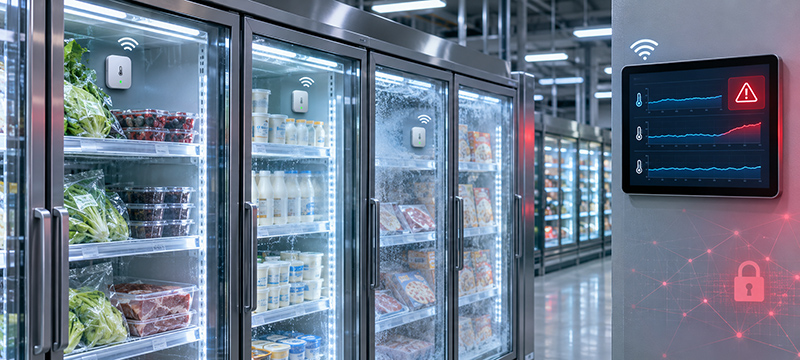
Ladle and Netmore are advocating an architecture in which temperature sensors, connectivity infrastructure and monitoring applications operate separately from refrigeration control systems and business IT networks.
Ladle’s ComplianceMate Continuous Temperature Monitoring (CTM) solution places wireless sensors inside refrigerators, freezers and walk-in cold storage areas. The sensors collect temperature measurements every 10 minutes, while the platform provides alerts when readings move outside predefined ranges.
The system can retain measurements during connectivity interruptions and maintain exportable temperature records for inspection and insurance purposes.
Importantly, the sensors monitor temperature and humidity without providing any mechanism to modify refrigeration equipment settings. This read-only architecture limits the monitoring system’s ability to affect the equipment it supervises.
Netmore supplies the underlying wireless connectivity through LoRaWAN networks. The technology uses separate network and application session keys, with AES-128-based security mechanisms supporting device authentication, message integrity and end-to-end application data encryption.
By separating monitoring communications from refrigeration controllers and conventional enterprise networks, the architecture reduces the risk that a compromise affecting equipment controls will simultaneously prevent temperature alerts from reaching operators.
What independent IoT monitoring can and cannot prevent
The distinction between monitoring and control is central to the companies’ proposition. Independent temperature sensors cannot prevent attackers from changing refrigeration settings or eliminate vulnerabilities in exposed controllers. Their purpose is to provide a separate source of operational information when primary systems become unreliable.
This has practical implications for systems integrators and facility operators. Deploying independent monitoring requires attention not only to wireless coverage and sensor placement, but also to alert routing, connectivity resilience and procedures for responding outside normal operating hours.
A secure communication channel alone does not guarantee operational continuity. Someone must receive the warning, recognize its significance and intervene before temperatures reach unsafe levels.
The approach also has relevance beyond grocery refrigeration. Healthcare facilities, pharmaceutical storage operators and other temperature-sensitive environments face similar dependencies between connected equipment, monitoring infrastructure and operational response.
From cybersecurity to operational resilience
Alongside its monitoring solution, Ladle has introduced Cold Chain Checklists intended to help operators assess four areas: exposure of refrigeration controllers, independence of monitoring systems, incident response readiness and insurance coverage for cyber-related spoilage.
These considerations underline an important distinction in IoT cybersecurity. Protecting connected equipment against unauthorized access remains essential, but organizations also need mechanisms to detect physical consequences when preventive controls fail.
For enterprises managing distributed refrigeration assets, the Ladle-Netmore approach illustrates how a separate LPWAN monitoring layer can support that objective without requiring access to equipment control functions.
The recent European incidents make the case particularly relevant: in connected industrial environments, resilience increasingly depends not just on securing operational systems, but on ensuring that critical measurements remain available when those systems are compromised.
The post Ladle and Netmore Highlight LoRaWAN’s Role in Securing Refrigeration Monitoring After Cyberattacks appeared first on IoT Business News.