
Romina Boccia and Ivane Nachkebia
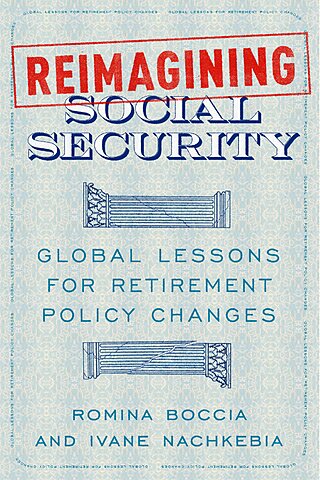
Ninety-one years after Social Security became law, the program faces its largest-ever financing shortfall. Today also marks one year after publishing Reimagining Social Security: Global Lessons for Retirement Policy Changes, with many of the trends we warned about having accelerated, making the case for structural reform even stronger. Since its publication in 2025, Reimagining Social Security has become part of the national conversation on Social Security reform, having been featured in the media, cited by policymakers, and discussed at leading academic conferences. Its core messages include:
The program has drifted away from its original purpose. Social Security has evolved into an increasingly expensive middle-class income replacement program rather than a focused guarantee against poverty in old age.
The financing issues are structural. The shortfall is driven by demographic change and benefit design and cannot realistically be resolved through faster growth, higher inflation, or taxing only “the rich.”
Other countries have shown that reform is possible. Many advanced economies have responded to aging populations by raising retirement ages, modifying benefit formulas, strengthening private savings, and targeting public benefits more effectively. The United States can learn from their experiences.
Structural reform can strengthen retirement security. A more targeted system can better protect poor seniors while improving fiscal sustainability and increasing economic growth by expanding opportunities for personal saving and wealth accumulation.
Delay makes reform more painful. Every year Congress delays reforms, which means that the eventual adjustments become larger and more abrupt.
The book’s origins trace back to May 2024, when we convened a diverse group of US and international experts at the Cato Institute’s “Social Security Symposium: A Global Perspective.” The event examined Social Security’s financing challenges and explored solutions inspired by reforms adopted in other advanced economies facing similar demographic pressures.
These international experiences demonstrated that retirement reform is possible despite the political barriers that have long hindered such efforts in the United States. Those discussions became the foundation for Reimagining Social Security, which offers policymakers practical, evidence-based retirement reforms informed by international experiences.
We published the original hardcover edition a year later, in August 2025, on the symbolic date of Social Security’s 90th anniversary. We’re pleased that the first print run is nearly sold out and excited to announce that a paperback edition will be published later this year.
Back then, the program’s retirement trust fund was projected to be exhausted in 2033, just eight years away. One year later, as the paperback edition goes to press, Social Security’s financial outlook has deteriorated further, moving the projected insolvency date forward by one year, from 2033 to 2032.
These developments underscore the urgency of structural reform, making the recommendations outlined in the book as relevant as ever. We’re encouraged to see it make a growing contribution to the debate over Social Security reform over the past year.
Since publication, the book has shaped discussions among policymakers, scholars, journalists, and advocates across the political spectrum. The launch event at the Cato Institute brought together leading Social Security experts and drew 70 in-person attendees, with over 460 people joining online. We later organized another event examining an often-overlooked aspect of Social Security: its substantial contribution to federal debt and deficits. That event attracted more than 120 in-person attendees, with more than 500 joining us online.
Reimagining Social Security and its central recommendation to transition the program to a flat-benefit system have also been featured in Forbes, The Hill, the Daily Upside, and on numerous podcasts, including Razib Khan’s Unsupervised Learning, CEI’s Free the Economy, and AIER’s Qualified Opinions. We’re especially grateful that it was reviewed in Law & Liberty and the Daily Economy.
Serious reform proposals deserve serious scrutiny. Reimagining Social Security received thoughtful critiques in MarketWatch from Alicia H. Munnell of the Center for Retirement Research at Boston College and from Wendell Primus, Ben Graham, Chloe Zilkha, and Sonia Jain of the Brookings Institution. We recently responded to the latter, and Boccia will debate Primus on Social Security today at 11am ET. We welcome these critiques because we believe that Social Security’s growth and looming insolvency demand honest engagement with competing ideas.
The book has also attracted policymakers’ attention. The 2026 Joint Economic Committee Republican Report, in the chapter titled “The Intergenerational Imbalance and Growing Dependence on a Shrinking Workforce,” cites our proposed structural benefit reforms as an approach that “could restore fiscal balance without increasing senior poverty.” Relatedly, the Cato Institute has developed a Social Security model capable of scoring a wide range of policy options. We have used this model to analyze proposals for congressional offices and regularly brief policymakers on Capitol Hill about Social Security’s long-term challenges and potential reforms.
Notably, public opinion appears receptive to the book’s primary recommendation. In December 2025, the Cato Institute conducted a nationally representative Social Security survey, examining Americans’ views on various proposals to address the program’s funding shortfall. Nearly half of all respondents (48 percent) supported transitioning Social Security to a flat-benefit system. Support was especially strong among younger Americans, reaching 63 percent among adults ages 18–29 and 57 percent among those ages 30–44.
Reimagining Social Security has also been a part of academic discussions on retirement policy. In 2026, we presented a paper that builds on the book’s core themes at one of the leading academic conferences on retirement policy, organized by the Pension Research Council of the Wharton School. We also presented the book’s ideas at the Association of Private Enterprise Education and Public Choice Society conferences and had the opportunity to discuss them with experts from across the political spectrum at the Brookings Institution and the National Academy of Social Insurance.
Encouragingly, one of the few positive legislative developments on Social Security in recent years has been the introduction of the bipartisan Protecting Retirement Opportunities and Maintaining Income Security for Everyone (PROMISE) Act in July 2026. If enacted, the bill would task the independent Social Security Advisory Board with producing a 50-year solvency plan, which Congress would then consider through an expedited process. Notably, Cato polling shows that 71 percent of Americans favor creating a commission of independent, nonpartisan experts to address the program’s funding shortfall.
Whether through a process established under the PROMISE Act or other legislative efforts, Social Security’s financing problems will not resolve themselves. Every year of delay narrows lawmakers’ options and raises the eventual costs of reform. Our hope is that Reimagining Social Security helps move the conversation beyond denial and toward reforms that improve fiscal sustainability, strengthen retirement security, and enable younger generations to build wealth.