
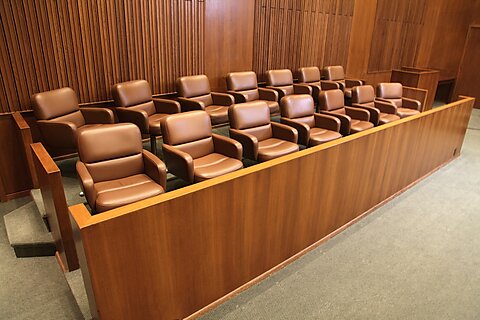
Kian v. Florida: The Right to Be Tried Before a Twelve-Person Jury
When Hamed Kian was charged in Florida with five counts of practicing chiropractic medicine with a suspended license—a felony carrying up to five years in prison—he was tried before a six-person jury. Convicted on all counts by this truncated panel, Mr. Kian appealed, arguing that Florida’s six-person jury rule deprived him of his right to a trial by a twelve-person jury as required by the Sixth and Fourteenth Amendments. The Florida appellate court affirmed his conviction without a written opinion, and Mr. Kian asked the US Supreme Court to review his case.
In trying felony cases before six-person juries, Florida’s reliance on the Supreme Court’s 1970 decision in Williams v. Florida breaks from centuries of tradition. The Framers incorporated the common-law criminal jury into Article III and the Sixth Amendment as a vital structural check against government overreach, overzealous prosecution, and judicial bias. While the Constitution’s text does not explicitly specify a numerical requirement, the Court’s recent originalist jurisprudence—most notably in Ramos v. Louisiana—reaffirms that the Sixth Amendment protects the fundamental attributes the criminal jury possessed at common law. Historically, the requirement that a criminal petit jury consist of precisely twelve members remained undisputed in English and American law for hundreds of years until Williams improperly abandoned that historical scope.
The Williams decision replaced historical originalism with a flawed “functionalist” approach, relying on questionable social science to assert that a six-person panel could perform the same democratic functions as a traditional twelve-person jury. Modern empirical research has thoroughly debunked this premise, showing that twelve-person juries deliberate more thoroughly, recall evidence more accurately, better incorporate minority voices, and ensure greater community representation. Moreover, this functionalist line-drawing has eroded the civic role of the jury, which serves as a primary avenue for popular sovereignty and public participation in the justice system.
The Supreme Court granted Mr. Kian’s petition, and the Cato Institute filed an amicus brief in support of Mr. Kian. In our brief, we ask the justices to overrule Williams v. Florida and reverse the decision. Our brief stresses that the structural guarantees of the Bill of Rights cannot be subjected to arbitrary judicial interest-balancing or functionalist reduction.
Restoring the common law twelve-person jury requirement is essential to protecting defendants’ constitutional rights, maintaining public confidence in judicial outcomes, and upholding the original meaning of the Sixth Amendment.