
A visitor to an IoT company’s website must often assess a complex proposition in seconds: connected devices, communications networks, software platforms, and the operational benefits they deliver. Dense copy and technical acronyms can obscure that value. A clear explainer video changes the sequence: it introduces a practical problem, shows how the connected solution works, and gives viewers a reason to explore further. By making an IoT deployment easier to understand, visual storytelling can help qualified visitors evaluate the offer and take the next step. The best results depend on deliberate choices about message, timing, design, and placement.
IoT buyers need enough technical detail to assess compatibility and fit, but a first website visit rarely allows for a full platform tour. A short narrative can identify the operational problem, show the connected workflow, and explain the resulting benefit. A tech explainer video can convey that sequence through motion, narration, and interface views, helping visitors understand a solution before they examine every specification.
Why Clarity Matters for IoT Buyers
Conversion begins with comprehension. Potential IoT customers need to connect device capabilities and platform features with familiar operational problems. An explainer should therefore lead with the buyer’s situation, not a catalog of sensors, protocols, or dashboards. For example, an industrial condition-monitoring solution can show a sensor collecting machine data, a connectivity layer transmitting it, and an application alerting maintenance teams to abnormal conditions. That gives buyers a clearer picture of the workflow before a sales conversation begins.
A clear explanation can also reduce uncertainty. IoT projects often involve integration with existing equipment, IT systems, and operational processes, as well as questions about deployment effort, connectivity, and security. A focused video can address these concerns by depicting where devices sit, how information flows, and who acts on the resulting insights. Visitors can then spend more time assessing whether the solution fits their use case rather than decoding terminology.
Build the Message Around One Buyer Decision
The video needs one primary conversion task. An IoT landing page may invite visitors to book a technical consultation, request a platform demonstration, start a proof of concept, or download an integration guide. The video should reinforce one of those actions. A single call to action (CTA) makes the next step easier to identify. Its wording should match the page, and its position should follow the point at which the solution’s value becomes clear.
Message discipline matters because IoT offerings can span hardware specifications, network coverage, cloud infrastructure, device management, and analytics. The script should identify the operational challenge, explain only the relevant parts of the architecture, and connect them to a plausible business outcome, such as improved asset visibility or reduced manual inspections. Detailed protocol support, security requirements, and integration documentation can remain below the video or in linked technical resources. This keeps the introduction concise without withholding information from serious evaluators.
Use Visuals to Show the Connected Workflow
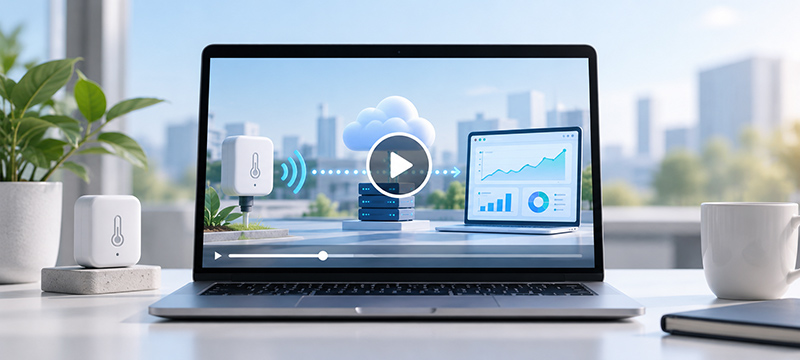
Visuals are particularly useful for explaining relationships between physical assets and digital services. An animation can follow data from a field sensor through a gateway or cellular connection to an IoT platform, while interface footage can show an operator reviewing an alert or device status. The depiction should reflect the actual architecture rather than imply capabilities the product does not offer. Motion should support the narration, not distract from it. Clear labels and captions can help viewers distinguish devices, networks, applications, and user actions.
A product demonstration becomes more persuasive when it follows the steps a prospective customer would actually take. Showing device onboarding, a live monitoring dashboard, or an alert-handling workflow can make the effort and outputs more tangible. For IoT products, accuracy is essential: the video must not misrepresent connectivity, automation, interoperability, or real-time capabilities. Reviews should check the interface footage, narration, captions, and links whenever the solution changes.
Place the Video Where IoT Buyers Have Questions
Placement affects both who watches and what happens next. A video near the headline can introduce an unfamiliar IoT solution, while a video beside architecture details, industry use cases, or a request-demo form can support a more technical evaluation. Surrounding copy should state what viewers will learn, such as a one-minute overview of remote asset monitoring or a walk-through of device onboarding. The video should serve a specific purpose on the page rather than sit apart from the buyer’s decision process.
Performance data should guide revisions. IoT marketers can compare video starts, completion rates, click-throughs, demonstration requests, and other meaningful conversions against the page’s baseline. A low start rate may indicate weak placement or an unclear thumbnail. High starts with low completion may suggest an overly technical opening. Viewers who finish but do not act may need a more relevant CTA or clearer explanation of the intended next step. These patterns are diagnostic signals, not proof of causation, so changes should be tested.
Conclusion
A clear explainer video can help an IoT company turn technical complexity into a comprehensible customer journey. It should connect a recognizable operational problem to a credible depiction of connected devices, data flows, and outcomes, then direct the viewer toward one relevant action. Before publication, marketing and technical teams should review the opening, architecture visuals, captions, links, and conversion path. Ongoing measurement can then show whether the video contributes to more informed engagement and qualified inquiries.
The post Why Clear IoT Explainer Videos Help Convert Website Visitors appeared first on IoT Business News.