
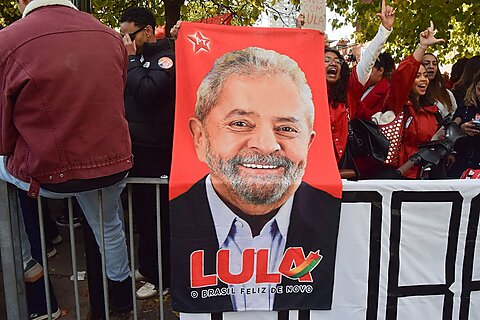
On October 25, Brazilians went to the polls for the presidential runoff between left-wing incumbent Lula da Silva and right-wing challenger Flávio Bolsonaro. With 52 percent of the vote, President Da Silva was declared the winner, but election night was anything but normal and once again raised serious concerns about the state of Brazilian democracy.
After 4:20 p.m., Da Silva’s party asked Brazil’s Supreme Court to extend voting by two hours wherever issues were reported. At 4:40 p.m., Bolsonaro’s party asked the country’s Electoral Court, which the Constitution tasks with organizing elections, to extend voting hours in three states where heavy rains kept voters from reaching the polls.
Reportedly, Supreme Court Justice Cristiano Zanin was randomly assigned to the case. Zanin is the former personal lawyer of President Da Silva, who arrived at election day as the underdog, having been defeated 47 to 45 percent by Bolsonaro in the first round. Da Silva appointed Zanin to the Court in 2023. At 5 p.m., as polls were closing throughout the country, Zanin issued a directive extending voting hours nationwide until 7 p.m.
Zanin proceeded with the extension even though some Electoral Court judges, and even some of his colleagues, disagreed with his decision. In fact, Supreme Court Justice Kassio Nunes Marques, who is also the president of the Electoral Court, said that Zanin’s decision caused “difficulties” and stressed the fact that the Electoral Court has “exclusive” jurisdiction over electoral matters: it is still not clear why the Supreme Court should have the authority to override the court created specifically to run elections.
Even more worrying, polls were closing by 5 p.m., and results were already being reported; thus, Zanin’s extension was not applied universally. Nunes Marques said the extension did not alter the vote count, but Flávio Bolsonaro refused to concede and called for the annulment of the election
Selective judicial interference was not limited to election day. Between the first and second rounds, President Da Silva took several measures to reverse his initial loss, even moving up social security payments so they would land right before election day. These decisions have yet to be ruled on, despite several early lawsuits, even though Brazilian electoral law prohibits policy measures that affect the equal standing of candidates during the campaign. Before the first round, judicial interference had also benefited Da Silva: a judge he had unilaterally appointed barred a TV channel from showing an empty lectern in a debate he chose to skip.
Judicial interference is not new in Brazil. In the past, the Supreme Court censored entire social media platforms such as X, as well as critics of the Da Silva government and of the court itself. As my colleague David Inserra wrote, the judiciary in Brazil acts “as victim, prosecutor, judge, juror, and executioner.” Add to that the fact that judicial interference is consistently biased toward the left, and the result is a democracy that people do not trust. Brazil’s democracy is in trouble, but it has been for a while.