
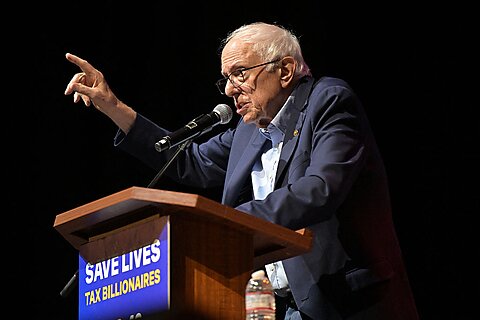
This is an excerpt from an article in the forthcoming issue of Free Society, which will be published on November 13.
The debate over California’s Proposition 40, a proposal for a one-time tax of 5 percent on billionaires’ assets, highlights a revealing tension in the politics of taxing wealth. Governor Gavin Newsom opposed the measure, arguing that wealthy Californians could easily leave the state and take their taxable income with them. Instead, he proposed a national billionaire tax. To a wealth tax skeptic, Newsom’s logic may seem backward. If the concern is that a wealth tax imposes high economic costs, applying it to more taxpayers would simply amplify those costs, not eliminate them.
Newsom is implicitly acknowledging the problem that Mark Cuban put more colorfully when he warned that the new California tax would push entrepreneurs and investors to other states: “If this passes, only idiot startup founders stay in Cali.”
The Newsom two-step illustrates an important political economy insight. A California wealth tax would concentrate its consequences in California. As taxpayers and businesses leave the state, taking their economic activity and employment opportunities with them, the costs of policy failure would be unusually visible.
Supporters sell these taxes as a virtually costless way to raise substantial revenue. Yet they also repeatedly push for upward harmonization: from states to the national level and from individual countries toward international coordination. The desire to limit mobility implicitly recognizes that taxpayers, investment, and businesses respond to taxes.
Limiting taxpayers’ ability to exit doesn’t make the tax costless. It simply makes the costs harder to see. Instead of newsy headlines about billionaires moving to Florida or Panama to cut their tax bills, the costs accumulate less visibly in the form of reduced investment, fewer entrepreneurs with unicorn startups, slower productivity growth, and, ultimately, fewer jobs and lower wages.
The Golden State’s Experiment
There are plenty of reasons to be skeptical of the California proposal.
A wealth tax applies to a stock of assets rather than a flow of earnings, regardless of whether the assets produce any income. Someone can own a business that is valuable on paper without receiving even a small percentage of that value in cash each year. To pay the tax bill, many paper billionaires may end up selling shares or forcing their business to distribute money that otherwise could have financed its growth.
At California’s proposed wealth tax rate of 5 percent, any asset earning less than a 5 percent annual pretax return would face marginal effective income tax rates above 100 percent, even before paying other taxes.
Determining the value of taxable wealth is no small task either. Publicly traded stock has a market price. Most of the other assets owned by the superwealthy—closely held businesses, partnership interests, intellectual property, artwork, and unique real estate, to name a few—are harder to value. California’s proposal acknowledges some of these valuation problems with unusually rigid, formula-driven rules for valuing hard-to-price assets. By substituting administrative convenience for actual market values, this system can increase economic costs by creating a large gap between actual and assessed values in most cases.
One illustration of how large these discrepancies can be is the Michael Jackson estate, which spent more than a decade litigating with the IRS after his death. Jackson’s estate valued his name and likeness at just $2,105 in 2009. The IRS said it was worth $434 million. In 2021, the Tax Court ultimately settled on $4.2 million. A national annual wealth tax would recreate this sort of dispute across potentially tens of thousands of taxpayers, every single year.
Given the economic and administrative burdens of wealth taxes, the California proposal will include strong incentives to move out of the state. The state’s own legislative analyst expects Proposition 40 to raise tens of billions of dollars in temporary revenue while also reducing state income tax revenues on an ongoing basis as wealthy taxpayers move away.
Other estimates are more striking. A Hoover Institution analysis estimates that nearly 30 percent of the anticipated tax base had already left California before the initiative qualified for the ballot. This finding undermines proponents’ claims that they’ve designed a one-time retroactive tax that will not affect taxpayer behavior.
After accounting for the lost income taxes from departing billionaires, the Hoover authors estimate that Proposition 40 could eventually reduce net state revenue by $25 billion over time. And these estimates are likely conservative, as they assume only billionaires would respond, not the many other entrepreneurs and investors who might reasonably expect future wealth taxes to reach them. Nor do they account for the Californians at all income levels who may flee the state as reduced investment depresses wages and job prospects.
Wealth Isn’t Piles of Gold
Part of the political appeal of wealth taxes is built on a misunderstanding of wealth. It is often imagined that the largest American fortunes are piles of gold in a vault somewhere, taken from the rest of us and hoarded by a few families, passed down for generations. But the overwhelming majority of top-end American wealth is productive capital that benefits all of us. And that wealth is mostly built by entrepreneurs, not inherited by them.
Among the richest 0.1 percent of households, 73 percent of net wealth is equity in privately held or publicly traded companies. Among billionaires, homes and personal assets such as cars, airplanes, artwork, and jewelry account for only a couple of percentage points of total wealth.
As Jeff Bezos’s wealth grows because Amazon is more valuable, his fortune does not mechanically make everyone else poorer. The company’s value—and thus much of Bezos’s wealth—reflects the firm’s expected future earnings, which are a function of how much consumers value the goods and services it provides. As my colleague Marian Tupy recently noted in the Wall Street Journal, Bezos has captured only a small fraction of the value his company has created for global consumers.
And the wealthy often don’t build just their own businesses; they risk their wealth to fund new ones started by others. Apple, Amazon, Google, Nvidia, Moderna, BioNTech, and countless other groundbreaking companies depended, at critical stages, on investors willing to risk their wealth to fund uncertain ideas.
These stories of innovation and entrepreneurship show how capital and labor are most often complements in production. More investment in capital makes workers more productive, and higher productivity is a key reason workers can demand higher wages.
Our public policies telegraph a message about our culture, our institutions, and what we value. A wealth tax says: “Don’t get too successful here. We want only middling ideas. If you have a really good idea, certainly don’t sell it to too many people.” That message doesn’t just stunt the lifestyles of the rich. Its broader costs fall on everyone through the jobs never created, cures never discovered, and technological breakthroughs never pursued.